Pearson+ LogoPearson+ Logo
Ch.9 Solutions
Timberlake - Chemistry: An Introduction to General, Organic, and Biological Chemistry 14th Edition
Timberlake14thChemistry: An Introduction to General, Organic, and Biological ChemistryISBN: 9781292472249Not the one you use?Change textbook
Chapter 9, Problem 31d

Predict whether each of the following ionic compounds is soluble in water: d. CuO

Verified step by step guidance
1
Step 1: Recall the solubility rules for ionic compounds in water. These rules help predict whether a compound will dissolve in water. For example, compounds containing alkali metal ions (e.g., Na⁺, K⁺) and ammonium ions (NH₄⁺) are generally soluble, as are nitrates (NO₃⁻), acetates (CH₃COO⁻), and most chlorides (Cl⁻), bromides (Br⁻), and iodides (I⁻).
Step 2: Identify the ions present in CuO. Copper(II) oxide consists of Cu²⁺ (copper ion) and O²⁻ (oxide ion).
Step 3: Check the solubility rules for compounds containing oxide ions (O²⁻). Oxides are generally insoluble in water, except for those of alkali metals and some alkaline earth metals (e.g., BaO).
Step 4: Determine if Cu²⁺ is an exception to the general insolubility of oxides. Copper(II) oxide does not fall under the exceptions for oxide solubility, as Cu²⁺ is not an alkali or alkaline earth metal ion.
Step 5: Conclude that CuO is generally insoluble in water based on the solubility rules and the nature of its ions.

Verified video answer for a similar problem:

This video solution was recommended by our tutors as helpful for the problem above.
Video duration:
42s
Was this helpful?

Key Concepts

Here are the essential concepts you must grasp in order to answer the question correctly.

Ionic Compounds

Ionic compounds are formed when atoms transfer electrons, resulting in the formation of positively and negatively charged ions. These compounds typically consist of a metal and a non-metal, and their properties include high melting and boiling points, as well as electrical conductivity when dissolved in water or molten.
Recommended video:
Guided course
02:11
Naming Ionic Compounds

Solubility Rules

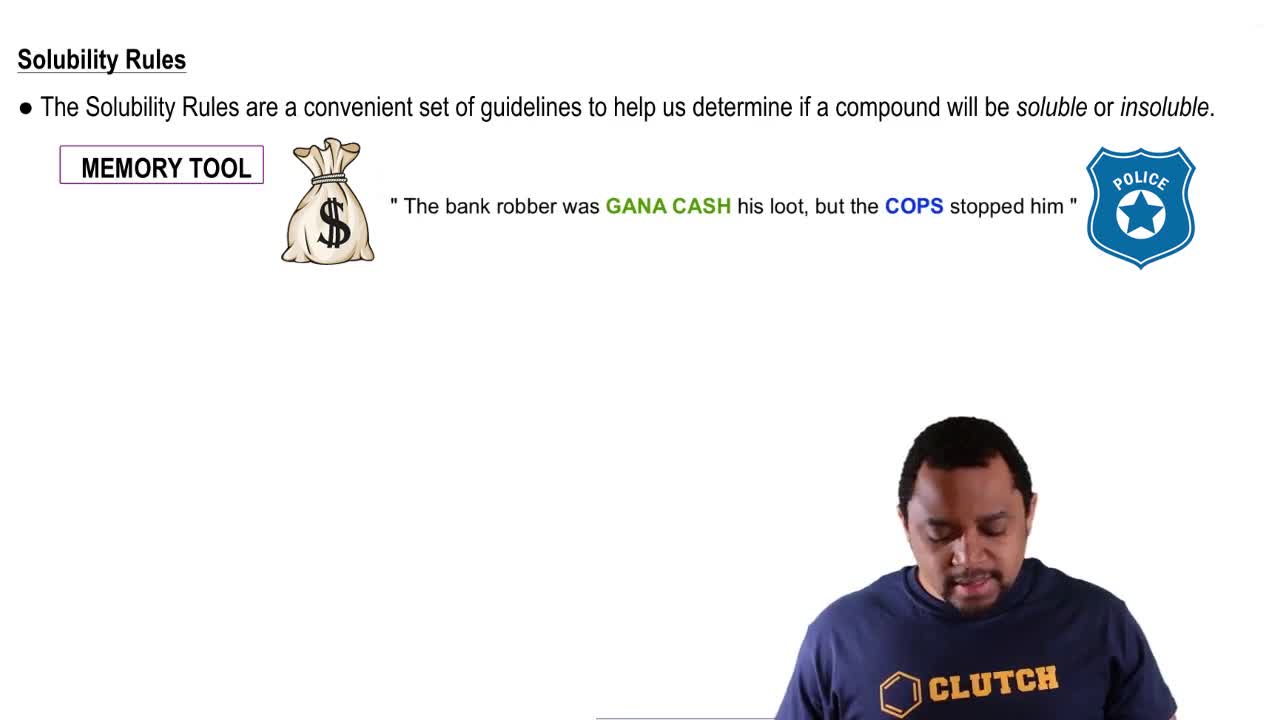
Solubility rules are guidelines that help predict whether an ionic compound will dissolve in water. These rules take into account the nature of the ions involved, with common soluble compounds including those containing alkali metals, ammonium, and nitrate ions, while many metal oxides, like CuO, are generally insoluble.
Recommended video:
Guided course
00:28
Solubility Rules

Copper(II) Oxide (CuO)

Copper(II) oxide (CuO) is a black solid that is an example of a metal oxide. According to solubility rules, most metal oxides are insoluble in water, which means that CuO does not dissolve in water, making it an important consideration when predicting the solubility of ionic compounds.
Recommended video:
Guided course
1:47
Oxidation of Monosaccharides Concept 1