Ch. 10 - Reactions of Alcohols, Ethers, Epoxides, Amines, and Sulfur-Containing Compounds
Bruice - Organic Chemistry 8th Edition
Bruice8th EditionOrganic ChemistryISBN: 9780135213711Non è quello che usi tu?Cambia libro di testo
Capitolo 10, Problema 77b

Propose a mechanism for each of the following reactions:
b.

Guida verificata passo dopo passo
1
Step 1: Analyze the reactant structure. The molecule contains two hydroxyl (-OH) groups attached to a bicyclic system. The reaction conditions include concentrated sulfuric acid (H₂SO₄) and heat (Δ), which suggests an acid-catalyzed dehydration reaction leading to the formation of a ketone.
Step 2: Protonation of one of the hydroxyl groups. In the presence of H₂SO₄, one of the hydroxyl groups is protonated, forming a good leaving group (water). This step increases the electrophilicity of the carbon attached to the hydroxyl group.
Step 3: Loss of water to form a carbocation. The protonated hydroxyl group leaves as water, generating a carbocation intermediate. The stability of the carbocation is enhanced by the bicyclic structure, which can undergo rearrangement if necessary.
Step 4: Intramolecular rearrangement and formation of a ketone. The carbocation undergoes a hydride shift or alkyl shift to stabilize the intermediate, followed by the migration of a bond to form a double bond (C=O) at the appropriate position, resulting in the ketone product.
Step 5: Final product formation. The reaction concludes with the formation of the bicyclic ketone structure as shown in the product. The sulfuric acid acts as a catalyst and is regenerated at the end of the reaction.

Risposta video verificata per un problema simile:

Questa soluzione video è stata consigliata dai nostri tutor come utile per risolvere questo problema.
Durata del video:
7m

Concetti chiave

Ecco i concetti essenziali che devi comprendere per rispondere correttamente alla domanda.

Esterification Reaction

Esterification is a chemical reaction that forms an ester from an alcohol and a carboxylic acid, often in the presence of an acid catalyst. In this case, the reaction involves alcohols converting to ethers, which is a related process. The acid catalyst, such as sulfuric acid (H2SO4), helps to protonate the alcohol, making it a better leaving group and facilitating the formation of the ether.
Video consigliato:
Percorso guidato
1:21
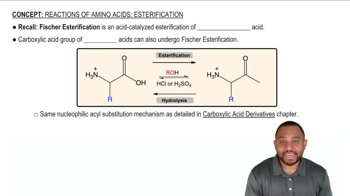
Reactions of Amino Acids: Esterification Concept 1

Protonation and Leaving Groups

Protonation is the addition of a proton (H+) to a molecule, which can enhance its reactivity. In the context of this reaction, the hydroxyl group (-OH) of the alcohol is protonated by H2SO4, converting it into a better leaving group (water). This step is crucial for the subsequent nucleophilic attack that leads to ether formation.
Video consigliato:
07:22
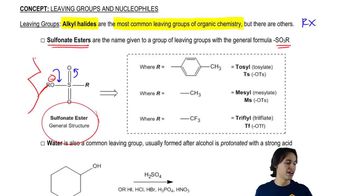
The 3 important leaving groups to know.

Nucleophilic Substitution Mechanism

Nucleophilic substitution is a fundamental reaction mechanism in organic chemistry where a nucleophile attacks an electrophile, resulting in the replacement of a leaving group. In this reaction, the ether formation involves the nucleophilic attack of the alcohol on the electrophilic carbon of the protonated alcohol, leading to the formation of the ether product. Understanding this mechanism is essential for proposing the correct reaction pathway.
Video consigliato:
01:47
Nucleophiles and Electrophiles can react in Substitution Reactions.