Ch. 10 - Reactions of Alcohols, Ethers, Epoxides, Amines, and Sulfur-Containing Compounds
Bruice - Organic Chemistry 8th Edition
Bruice8th EditionOrganic ChemistryISBN: 9780135213711Non è quello che usi tu?Cambia libro di testo
Capitolo 10, Problema 79

When ethyl ether is heated with excess HI for several hours, the only organic product obtained is ethyl iodide. Explain why ethyl alcohol is not obtained as a product.

Guida verificata passo dopo passo
1
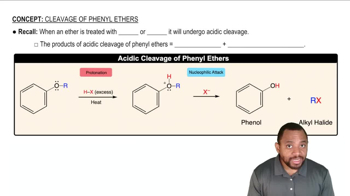
Understand the reaction: When ethyl ether (C₂H₅-O-C₂H₅) is heated with excess HI, the ether undergoes cleavage due to the strong nucleophilic and acidic nature of HI. This reaction is known as acid-catalyzed cleavage of ethers.
Recognize the mechanism: The reaction proceeds via protonation of the ether oxygen by HI, forming an oxonium ion (C₂H₅-O⁺-C₂H₅). This step makes the ether more susceptible to nucleophilic attack.
Identify the nucleophile: The iodide ion (I⁻) acts as a strong nucleophile and attacks one of the ethyl groups, breaking the C-O bond and forming ethyl iodide (C₂H₅I) and ethanol (C₂H₅OH) as intermediates.
Explain why ethyl alcohol is not isolated: Ethanol (C₂H₅OH) formed in the intermediate step reacts further with excess HI. The hydroxyl group (-OH) in ethanol is replaced by an iodide ion (I⁻) through a substitution reaction, producing another molecule of ethyl iodide (C₂H₅I).
Conclude the reasoning: Due to the excess HI and the reactivity of ethanol with HI, ethyl alcohol is not obtained as a final product. Instead, all the organic material is converted into ethyl iodide (C₂H₅I).

Risposta video verificata per un problema simile:

Questa soluzione video è stata consigliata dai nostri tutor come utile per risolvere questo problema.

Concetti chiave

Ecco i concetti essenziali che devi comprendere per rispondere correttamente alla domanda.

Ether Cleavage

Ethers, like ethyl ether, undergo cleavage when treated with strong acids such as hydroiodic acid (HI). This reaction involves the protonation of the ether oxygen, making it a better leaving group. The cleavage results in the formation of alkyl halides and alcohols, but the conditions can favor the formation of one product over another.
Video consigliato:
Percorso guidato
1:45
Cleavage of Phenyl Ethers Concept 1

Reactivity of Alkyl Halides

In the presence of excess HI, ethyl iodide is favored due to the reactivity of alkyl halides. Ethyl iodide can further react with HI to regenerate iodide ions and promote the cleavage of the ether. This reaction pathway leads to the exclusive formation of ethyl iodide rather than ethyl alcohol, which would require different conditions to form.
Video consigliato:
01:52
How to name alkyl halides

Equilibrium and Reaction Conditions

The reaction conditions, including the excess of HI and prolonged heating, shift the equilibrium towards the formation of ethyl iodide. The high concentration of HI drives the reaction to completion, minimizing the formation of ethyl alcohol. In contrast, if the conditions were less extreme, both products could potentially form.
Video consigliato:
04:00
Determining Acid/Base Equilibrium