Ch. 10 - Reactions of Alcohols, Ethers, Epoxides, Amines, and Sulfur-Containing Compounds
Bruice - Organic Chemistry 8th Edition
Bruice8th EditionOrganic ChemistryISBN: 9780135213711Non è quello che usi tu?Cambia libro di testo
Capitolo 10, Problema 80

When the following seven-membered ring alcohol is dehydrated, three alkenes are formed. Propose a mechanism for their formation.
Dehydration reaction of a seven-membered ring alcohol producing three alkenes with sulfuric acid as a catalyst.

Guida verificata passo dopo passo
1
Step 1: Recognize that the reaction involves acid-catalyzed dehydration of the alcohol. Sulfuric acid (H₂SO₄) acts as a catalyst, and heat (Δ) promotes the elimination of water to form alkenes.
Step 2: Protonation of the hydroxyl group occurs first. The alcohol group (-OH) is protonated by H₂SO₄, converting it into a better leaving group (water, H₂O). This step increases the electrophilicity of the carbon attached to the hydroxyl group.
Step 3: Formation of a carbocation intermediate. After the departure of water, a carbocation is formed at the carbon where the hydroxyl group was originally attached. The stability of this carbocation is influenced by hyperconjugation and alkyl substituents.
Step 4: Rearrangement of the carbocation. The seven-membered ring allows for possible hydride or alkyl shifts to form more stable carbocations. This rearrangement can lead to different carbocation intermediates, which will ultimately result in the formation of multiple alkenes.
Step 5: Elimination of a proton (E1 mechanism). A base (often the conjugate base of H₂SO₄) abstracts a proton from a β-carbon adjacent to the carbocation, leading to the formation of double bonds (alkenes). Depending on the position of the β-hydrogens, three different alkenes are formed as shown in the image.

Risposta video verificata per un problema simile:

Questa soluzione video è stata consigliata dai nostri tutor come utile per risolvere questo problema.
Durata del video:
12m

Concetti chiave

Ecco i concetti essenziali che devi comprendere per rispondere correttamente alla domanda.

Dehydration Reaction

Dehydration reactions involve the removal of a water molecule from a compound, often resulting in the formation of a double bond. In the context of alcohols, this process typically occurs under acidic conditions, where the hydroxyl group is protonated, making it a better leaving group. The elimination of water leads to the formation of alkenes, which can vary based on the structure of the starting material.
Video consigliato:
01:23
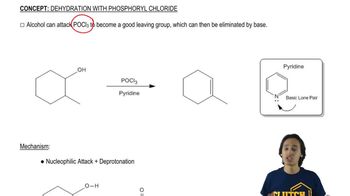
General Reaction of Dehydration with POCl3

Mechanism of Alkene Formation

The mechanism for alkene formation from alcohols generally follows an E1 or E2 pathway. In the E1 mechanism, the first step involves the formation of a carbocation after the leaving of water, followed by the elimination of a proton to form a double bond. In the E2 mechanism, the elimination occurs in a single concerted step, where a base abstracts a proton while the leaving group departs, leading to the formation of the alkene.
Video consigliato:
Percorso guidato
1:59
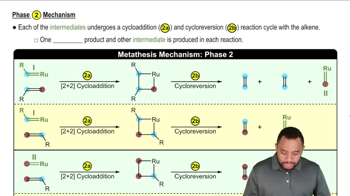
Alkene Metathesis Concept 5

Regioselectivity and Stereochemistry

Regioselectivity refers to the preference of a chemical reaction to yield one structural isomer over others. In the dehydration of the seven-membered ring alcohol, multiple alkenes can form due to different positions of double bond formation. Stereochemistry also plays a role, as the spatial arrangement of substituents around the double bond can lead to different geometric isomers, influencing the overall product distribution.
Video consigliato:
Percorso guidato
1:38
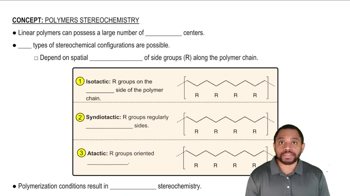
Polymer Stereochemistry Concept 1