Indietro
 Bruice 8th EditionCh. 10 - Reactions of Alcohols, Ethers, Epoxides, Amines, and Sulfur-Containing Compounds
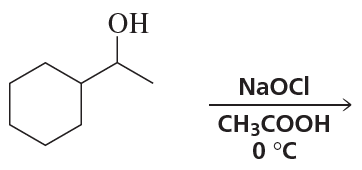
Problema 63h
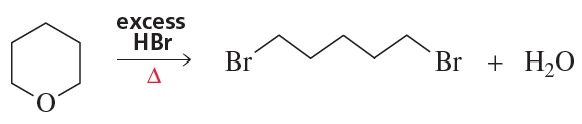
What is the major product(s) of each of the following reactions?
h.
Problema 64b
In Section 10.12, we saw that S-adenosylmethionine (SAM) methylates the nitrogen atom of noradrenaline to form adrenaline, a more potent hormone. If SAM methylates an OH group attached to the benzene ring instead, it completely destroys noradrenaline's activity.
b. Which reaction is more apt to occur, methylation on nitrogen or methylation on oxygen?
Problema 66
An unknown alcohol with a molecular formula of C7H14O was oxidized to an aldehyde with HOCl. When an acidic solution of the alcohol was distilled, two alkenes were obtained. The alkene formed in greater yield was determined to be 1-methylcyclohexene. The other alkene formed the original un-known alcohol when treated with BH3/THF followed by H2O2, HO-, and H2O. Identify the unknown alcohol.
Problema 67
Explain why the acid-catalyzed dehydration of an alcohol is a reversible reaction, whereas the base-promoted dehydrohalogenation of an alkyl halide is an irreversible reaction.
Problema 68
Explain why (S)-2-butanol forms a racemic mixture when it is heated in sulfuric acid.
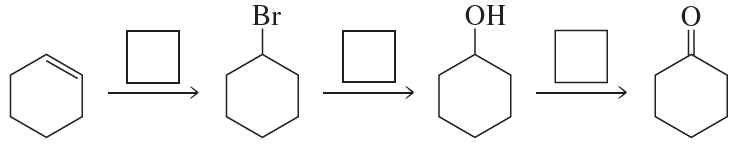
Problema 69a
Fill in each box with the appropriate reagent:
a.
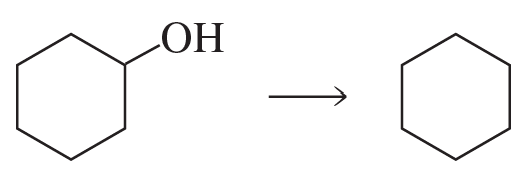
Problema 69c
Fill in each box with the appropriate reagent:
c.
Problema 70(8)
a. Draw the product or products that will be obtained from the reaction of cis-2-butene and trans-2-butene with each of the following reagents. If a product can exist as stereoisomers, show which stereoisomers are formed.
8. CH3OH + H2SO4
b. With which reagents do the two alkenes react to form different products?
Problema 71
What product would be formed if the four-membered ring alcohol in Problem 70 were heated with an equivalent amount of HBr rather than with a catalytic amount of H2SO4?
Problema 72
Which of the following ethers would be obtained in greatest yield directly from alcohols?
Problema 73a
Using the given starting material, any necessary inorganic reagents, and any carbon-containing compounds with no more than two carbons, indicate how the following syntheses could be carried out:
a.
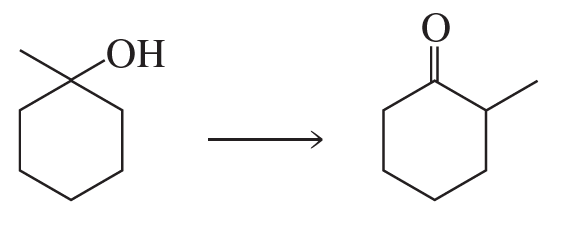
Problema 73b
Using the given starting material, any necessary inorganic reagents, and any carbon-containing compounds with no more than two carbons, indicate how the following syntheses could be carried out:
b.
Problema 74
When piperidine undergoes the series of reactions shown here, 1,4-pentadiene is obtained as the product. When the four different methyl-substituted piperidines undergo the same series of reactions, each forms a different diene: 1,5-hexadiene; 1,4-pentadiene; 2-methyl-1,4-pentadiene; and 3-methyl-1,4-pentadiene. Which methyl-substituted piperidine forms which diene?
Problema 75
When 3-methyl-2-butanol is heated with concentrated HBr, a rearranged product is obtained. When 2-methyl-1-propanol reacts under the same conditions, a rearranged product is not obtained. Explain.
Problema 76
Draw structures for compounds A–F.
Problema 77a
Propose a mechanism for each of the following reactions:
a.
Problema 77b
Propose a mechanism for each of the following reactions:
b.
Problema 78
How could you synthesize isopropyl propyl ether, using isopropyl alcohol as the only carbon-containing reagent?
Problema 79
When ethyl ether is heated with excess HI for several hours, the only organic product obtained is ethyl iodide. Explain why ethyl alcohol is not obtained as a product.
Problema 80
When the following seven-membered ring alcohol is dehydrated, three alkenes are formed. Propose a mechanism for their formation.
Problema 81
Ethylene oxide reacts readily with HO- because of the strain in the three-membered ring. Explain why cyclopropane, a compound with approximately the same amount of strain, does not react with HO-.
Problema 82a
Describe how each of the following compounds could be synthesized from the given starting material.
a.
Problema 83a
Propose a mechanism for each of the following reactions:
a.
Problema 83b
Propose a mechanism for each of the following reactions:
b.
Problema 84
Triethylene glycol is one of the products obtained from the reaction of excess ethylene oxide and hydroxide ion. Propose a mechanism for its formation.
Problema 85a
a. Propose a mechanism for the following reaction:
Problema 85b,c
b. A small amount of a product containing a six-membered ring is also formed. Draw the structure of that product.
c. Why is so little six-membered ring product formed?
Problema 86
Propose a mechanism for the following reaction:
Problema 89a
The following reaction takes place several times faster than the reaction of 2-chlorobutane with HO-:
a. Explain the enhanced reaction rate.
Problema 89b
The following reaction takes place several times faster than the reaction of 2-chlorobutane with HO-:
b. Explain why the OH group in the product is not bonded to the carbon that was bonded to the Cl group in the reactant.