Ch. 17 - Reactions at the Alpha-Carbon
Bruice - Organic Chemistry 8th Edition
Bruice8th EditionOrganic ChemistryISBN: 9780135213711Non è quello che usi tu?Cambia libro di testo
Capitolo 17, Problema 4

Explain why the α\(\alpha\)-hydrogen of an N,N-disubstituted amide is less acidic (pKa = 30) than the α\(\alpha\)-hydrogen of an ester (pKa = 25).

Guida verificata passo dopo passo
1
Identify the functional groups in the molecules: An N,N-disubstituted amide contains a carbonyl group (C=O) attached to a nitrogen atom with two substituents, while an ester contains a carbonyl group attached to an oxygen atom bonded to an alkyl group.
Recognize the key difference in electronegativity: The nitrogen atom in the amide is less electronegative than the oxygen atom in the ester. This means the nitrogen in the amide donates electron density more effectively to the carbonyl group, reducing the overall electron-withdrawing effect of the carbonyl group.
Understand the impact on the α-hydrogen: The α-hydrogen (the hydrogen on the carbon adjacent to the carbonyl group) is more acidic when the carbonyl group strongly withdraws electron density. In the ester, the oxygen atom enhances the electron-withdrawing effect of the carbonyl group, making the α-hydrogen more acidic. In contrast, the nitrogen in the amide reduces the electron-withdrawing effect, making the α-hydrogen less acidic.
Consider resonance stabilization of the conjugate base: When the α-hydrogen is removed, the resulting carbanion (conjugate base) can be stabilized by resonance with the carbonyl group. In the ester, the oxygen atom's higher electronegativity allows for better resonance stabilization of the conjugate base compared to the amide, where the nitrogen's electron-donating nature reduces resonance stabilization.
Conclude the reasoning: The combination of reduced electron-withdrawing ability and less effective resonance stabilization in the amide compared to the ester explains why the α-hydrogen of an N,N-disubstituted amide is less acidic (higher pKa) than the α-hydrogen of an ester.

Risposta video verificata per un problema simile:

Questa soluzione video è stata consigliata dai nostri tutor come utile per risolvere questo problema.
Durata del video:
8m

Concetti chiave

Ecco i concetti essenziali che devi comprendere per rispondere correttamente alla domanda.

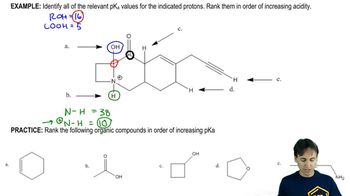
Acidity and pKa

Acidity refers to the tendency of a compound to donate a proton (H+). The pKa value is a quantitative measure of this acidity; lower pKa values indicate stronger acids. In organic chemistry, the stability of the resulting conjugate base after deprotonation significantly influences acidity. Understanding pKa values helps compare the acidity of different functional groups.
Video consigliato:
07:45
Identifying pKa values

Resonance Stabilization

Resonance stabilization occurs when a molecule can be represented by multiple valid Lewis structures, allowing for the delocalization of electrons. In the case of esters, the conjugate base formed after deprotonation can stabilize through resonance with the carbonyl group, enhancing its stability. This stabilization contributes to the higher acidity of esters compared to N,N-disubstituted amides.
Video consigliato:
03:43
The radical stability trend.

Inductive Effect

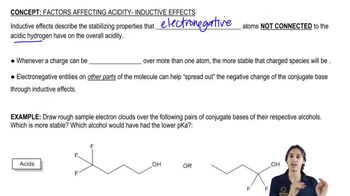
The inductive effect refers to the electron-withdrawing or electron-donating influence of substituents on a molecule. In N,N-disubstituted amides, the presence of electron-donating alkyl groups can reduce the acidity of the a-hydrogen by destabilizing the conjugate base. This contrasts with esters, where the carbonyl group can exert a stronger electron-withdrawing effect, enhancing acidity.
Video consigliato:
01:47
Understanding the Inductive Effect.