Ch. 18 - Reactions of Benzene and Substituted Benzenes
Bruice - Organic Chemistry 8th Edition
Bruice8th EditionOrganic ChemistryISBN: 9780135213711Non è quello che usi tu?Cambia libro di testo
Capitolo 18, Problema 50c(1,2)

For each horizontal row of substituted benzenes, indicate
c. the one that yields the highest percentage of meta product in an electrophilic aromatic substitution reaction.
1.
2.

Guida verificata passo dopo passo
1
Step 1: Analyze the substituents on the benzene rings in each row. Substituents can be classified as electron-donating groups (EDGs) or electron-withdrawing groups (EWGs). EDGs typically direct electrophilic substitution to the ortho/para positions, while EWGs favor the meta position.
Step 2: In the first row, the substituents are CH₃, CHF₂, and CF₃. CH₃ is an electron-donating group due to hyperconjugation, CHF₂ is moderately electron-withdrawing due to the electronegativity of fluorine, and CF₃ is strongly electron-withdrawing due to the inductive effect of three fluorine atoms. The CF₃ group will yield the highest percentage of meta product.
Step 3: In the second row, the substituents are N(CH₃)₃⁺, CH₂N(CH₃)₃⁺, and CH₂CH₂N(CH₃)₃⁺. All these substituents are electron-withdrawing due to the positive charge on the nitrogen atom. The strength of the electron-withdrawing effect decreases as the substituent is further away from the benzene ring. Therefore, N(CH₃)₃⁺, being directly attached to the ring, will yield the highest percentage of meta product.
Step 4: Consider the mechanism of electrophilic aromatic substitution. The meta position is favored by EWGs because they stabilize the carbocation intermediate formed during the reaction by reducing electron density at the ortho and para positions.
Step 5: Summarize the findings: In the first row, CF₃ yields the highest percentage of meta product. In the second row, N(CH₃)₃⁺ yields the highest percentage of meta product. This is due to the strong electron-withdrawing effects of these substituents.

Risposta video verificata per un problema simile:

Questa soluzione video è stata consigliata dai nostri tutor come utile per risolvere questo problema.
Durata del video:
3m

Concetti chiave

Ecco i concetti essenziali che devi comprendere per rispondere correttamente alla domanda.

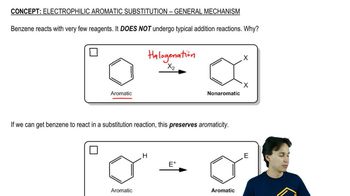
Electrophilic Aromatic Substitution (EAS)

Electrophilic Aromatic Substitution is a fundamental reaction in organic chemistry where an electrophile replaces a hydrogen atom on an aromatic ring. This reaction is crucial for synthesizing various aromatic compounds. The position of substitution (ortho, meta, or para) depends on the nature of the substituents already present on the ring, which can either activate or deactivate the ring towards further substitution.
Video consigliato:
03:07
EAS Review

Substituent Effects

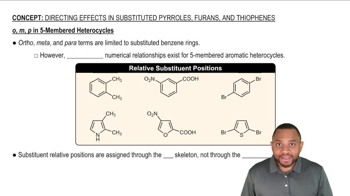
Substituent effects refer to how different groups attached to the benzene ring influence the reactivity and orientation of electrophilic aromatic substitution. Activating groups, such as -OH or -NH2, direct substitution to the ortho and para positions, while deactivating groups, like -NO2 or -CF3, favor meta substitution. Understanding these effects is essential for predicting the outcome of EAS reactions.
Video consigliato:
Percorso guidato
2:02
Directing Effects in Substituted Pyrroles, Furans, and Thiophenes Concept 1

Meta vs. Ortho/Para Products

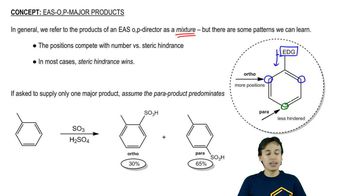
In electrophilic aromatic substitution, the orientation of the substituent can lead to different product distributions. Meta products are formed when the electrophile attacks the carbon atom adjacent to the substituent, while ortho and para products are formed when the electrophile attacks the carbons directly next to or opposite the substituent. The relative stability and electronic effects of the substituents determine which product is favored in terms of yield.
Video consigliato:
04:42
Ortho, Para major products