Ch. 18 - Reactions of Benzene and Substituted Benzenes
Bruice - Organic Chemistry 8th Edition
Bruice8th EditionOrganic ChemistryISBN: 9780135213711Non è quello che usi tu?Cambia libro di testo
Capitolo 18, Problema 85a

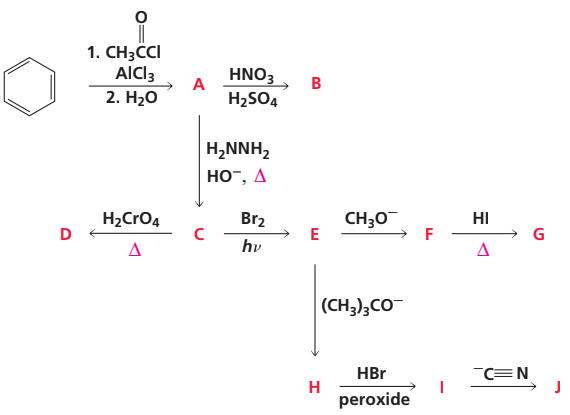
Identify A–J:

Guida verificata passo dopo passo
1
Step 1: Analyze the first reaction. The starting material is benzene, and it reacts with CH3CH2CCl/AlCl3. This is a Friedel-Crafts acylation reaction, where the acyl group (CH3CH2CO-) is introduced onto the benzene ring. The product A will be an aromatic ketone.
Step 2: Examine the second reaction. Compound A reacts with hydrazine (H2NNH2) in the presence of a base (HO-) and heat (Δ). This is the Wolff-Kishner reduction, which converts the carbonyl group (C=O) in ketones to a methylene group (-CH2). The product B will be an alkylbenzene.
Step 3: Note the presence of ethylene glycol (HOCH2CH2OH) in the second step. Ethylene glycol is often used as a solvent or stabilizing agent in high-temperature reactions, but it does not directly participate in the Wolff-Kishner reduction.
Step 4: Summarize the transformations. Compound A is formed by the acylation of benzene, resulting in an aromatic ketone. Compound B is formed by the reduction of the ketone group in A to a methylene group, yielding an alkylbenzene.
Step 5: To identify A and B, consider the specific acyl group introduced in the first step (CH3CH2CO-) and the subsequent reduction of the ketone group. A is ethyl phenyl ketone (C6H5COCH2CH3), and B is ethylbenzene (C6H5CH2CH3).

Risposta video verificata per un problema simile:

Questa soluzione video è stata consigliata dai nostri tutor come utile per risolvere questo problema.
Durata del video:
5m

Concetti chiave

Ecco i concetti essenziali che devi comprendere per rispondere correttamente alla domanda.

Friedel-Crafts Acylation

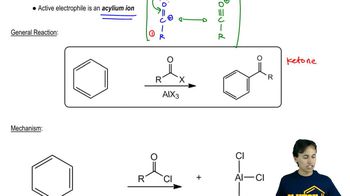
Friedel-Crafts acylation is a key reaction in organic chemistry that introduces an acyl group into an aromatic ring. This reaction typically involves the use of an acyl chloride and a Lewis acid catalyst, such as AlCl3, to form an acylaromatic compound. The product, compound A in the diagram, retains the aromaticity of the benzene ring while adding a carbonyl functional group.
Video consigliato:
05:20
Friedel-Crafts Acylation

Wolff-Kishner Reduction

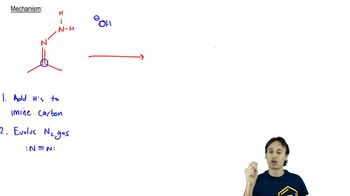
The Wolff-Kishner reduction is a method used to convert carbonyl compounds into alkanes by removing the oxygen functionality. This reaction employs hydrazine (H2NNH2) and a strong base, often under heat, to facilitate the reduction. In the provided diagram, the transformation from compound A to compound B illustrates this reduction process, resulting in the formation of an alkane.
Video consigliato:
04:57
Mechanism

Hydrazine and Base Reaction

Hydrazine (H2NNH2) acts as a reducing agent in organic reactions, particularly in the Wolff-Kishner reduction. When combined with a strong base, it promotes the conversion of carbonyl groups to hydrocarbons. The reaction typically requires heating to drive the elimination of nitrogen gas, leading to the formation of the final product, which is a diol in this case, as shown in the transformation from compound B.
Video consigliato:
02:43
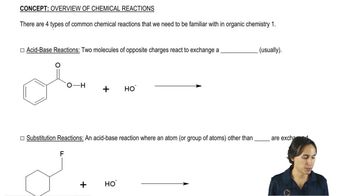
Recognizing Acid-Base Reactions.