Ch. 18 - Reactions of Benzene and Substituted Benzenes
Bruice - Organic Chemistry 8th Edition
Bruice8th EditionOrganic ChemistryISBN: 9780135213711Non è quello che usi tu?Cambia libro di testo
Capitolo 18, Problema 85b

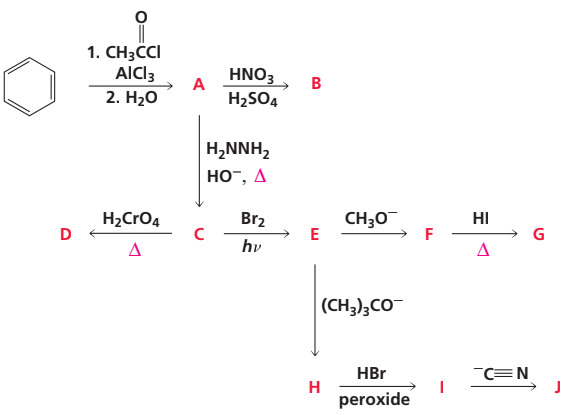
Identify A–J:

Guida verificata passo dopo passo
1
Step 1: Analyze the first reaction. The starting compound is isopropylbenzene (cumene). It reacts with bromine (Br₂) under UV light (hν), which indicates a free radical halogenation reaction. The bromine will selectively replace a hydrogen atom at the benzylic position (the carbon adjacent to the benzene ring) due to the stability of the benzylic radical.
Step 2: The product of the first reaction (A) is a benzylic bromide. In the second step, this benzylic bromide reacts with tert-butoxide (tert-BuO⁻), a strong base. This is an elimination reaction (E2 mechanism), where the bromine is eliminated along with a proton from the adjacent carbon, forming a double bond. The product (B) is an alkene at the benzylic position.
Step 3: The third reaction involves the addition of hydrogen iodide (HI) to the alkene (B) under heat (Δ). This is an electrophilic addition reaction. HI adds across the double bond, following Markovnikov's rule, where the iodine attaches to the benzylic carbon and the hydrogen attaches to the less substituted carbon.
Step 4: The final product (C) is a benzylic iodide. This compound is formed as a result of the addition of HI to the alkene.
Step 5: To summarize, the sequence of reactions involves free radical halogenation, elimination, and electrophilic addition. Each step transforms the functional group at the benzylic position, leading to the final product.

Risposta video verificata per un problema simile:

Questa soluzione video è stata consigliata dai nostri tutor come utile per risolvere questo problema.
Durata del video:
6m

Concetti chiave

Ecco i concetti essenziali che devi comprendere per rispondere correttamente alla domanda.

Radical Reactions

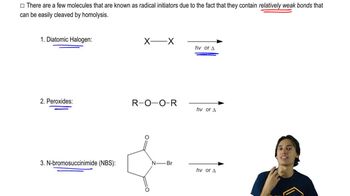
Radical reactions involve the formation and reaction of radicals, which are species with unpaired electrons. These reactions often require initiation steps, such as exposure to light (hv) or heat, to generate radicals from stable molecules. In this context, bromine (Br2) is used to generate a radical intermediate (A) through homolytic cleavage.
Video consigliato:
03:49
What are Radical Initiators?

Nucleophilic Substitution

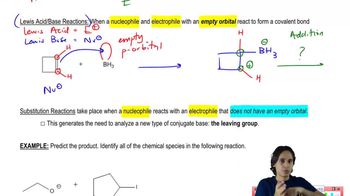
Nucleophilic substitution is a fundamental reaction in organic chemistry where a nucleophile replaces a leaving group in a molecule. In the reaction sequence, the tert-butoxide ion (tert-BuO-) acts as a nucleophile, attacking the radical intermediate (A) to form compound B. This step is crucial for the transformation of radicals into more stable products.
Video consigliato:
01:47
Nucleophiles and Electrophiles can react in Substitution Reactions.

Elimination Reactions

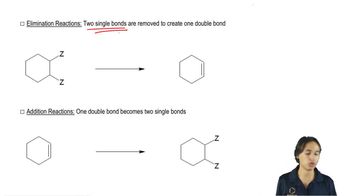
Elimination reactions involve the removal of atoms or groups from a molecule, resulting in the formation of a double bond or a ring structure. In this case, the reaction of compound B with hydrogen iodide (HI) under heat (Δ) leads to the elimination of a leaving group and the formation of compound C. Understanding elimination mechanisms is essential for predicting product formation in organic synthesis.
Video consigliato:
00:40
Recognizing Elimination Reactions.