Ch. 18 - Reactions of Benzene and Substituted Benzenes
Bruice - Organic Chemistry 8th Edition
Bruice8th EditionOrganic ChemistryISBN: 9780135213711Non è quello che usi tu?Cambia libro di testo
Capitolo 18, Problema 43c

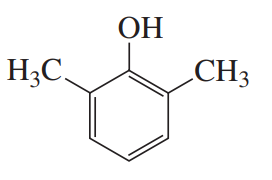
Name the following:
c. Benzene ring structure with hydroxyl (OH) and two methyl (H3C) groups attached.

Guida verificata passo dopo passo
1
Step 1: Identify the parent structure. The parent structure is a benzene ring, which is an aromatic compound.
Step 2: Determine the substituents attached to the benzene ring. The substituents are an amino group (-NH2) and two methyl groups (-CH3).
Step 3: Assign positions to the substituents on the benzene ring. The amino group (-NH2) is at position 1, and the methyl groups (-CH3) are at positions 2 and 4 relative to the amino group.
Step 4: Name the compound using IUPAC nomenclature rules. The amino group takes priority in naming, so the compound is named as an aminobenzene derivative. The methyl groups are named as substituents with their positions specified.
Step 5: Combine the substituent names and positions with the parent structure name. The final name is 2,4-dimethyl-1-aminobenzene, or commonly known as 2,4-dimethylaniline.

Risposta video verificata per un problema simile:

Questa soluzione video è stata consigliata dai nostri tutor come utile per risolvere questo problema.
Durata del video:
4m

Concetti chiave

Ecco i concetti essenziali che devi comprendere per rispondere correttamente alla domanda.

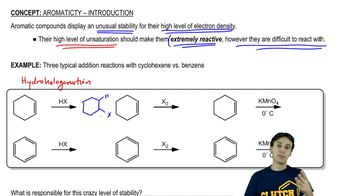
Aromatic Compounds

Aromatic compounds are a class of cyclic compounds that contain conjugated pi electron systems, which follow Hückel's rule (4n + 2 pi electrons). They are characterized by their stability and unique reactivity due to resonance. The benzene ring is the simplest example, and substituents can significantly influence the compound's properties and nomenclature.
Video consigliato:
08:19
Intro to Aromaticity

Substituent Effects

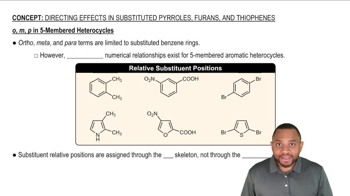
Substituent effects refer to how different groups attached to a benzene ring can influence its chemical behavior and reactivity. Groups can be classified as electron-donating or electron-withdrawing, affecting the electron density of the ring and its reactivity towards electrophiles. In this case, the amino group (-NH2) is an electron-donating group, while the methyl groups (-CH3) are also electron-donating, impacting the overall stability and reactivity of the compound.
Video consigliato:
Percorso guidato
2:02
Directing Effects in Substituted Pyrroles, Furans, and Thiophenes Concept 1

Nomenclature of Organic Compounds

The nomenclature of organic compounds follows specific rules set by the International Union of Pure and Applied Chemistry (IUPAC). For aromatic compounds, the position of substituents on the benzene ring is crucial for naming. In this structure, the amino group and two methyl groups need to be identified and numbered correctly to derive the compound's systematic name, considering the priority of functional groups.
Video consigliato:
01:40
Defining meso compounds.