
Ch. 2 - Acids and Bases: Central to Understanding Organic Chemistry
Bruice - Organic Chemistry 8th Edition
Bruice8th EditionOrganic ChemistryISBN: 9780135213711Non è quello che usi tu?Cambia libro di testo
Capitolo 2, Problema 64

For each compound, indicate the atom that is most apt to be protonated.
a.
b.
c.

Guida verificata passo dopo passo
1
Step 1: Analyze the functional groups in each compound. Protonation typically occurs at atoms with lone pairs of electrons, such as oxygen or nitrogen, because they can accept a proton (H⁺).
Step 2: For compound (a), identify the functional groups: it contains an -OH group (hydroxyl) and an -NH₂ group (amine). Both oxygen and nitrogen have lone pairs, but nitrogen is more basic and more likely to be protonated.
Step 3: For compound (b), identify the functional groups: it contains an -OH group attached to a tertiary carbon and an -NH₂ group. The nitrogen atom in the -NH₂ group is more basic than the oxygen atom in the -OH group, so nitrogen is the most likely site for protonation.
Step 4: For compound (c), identify the functional groups: it contains an -NH₂ group and a -CH₂OH group. The nitrogen atom in the -NH₂ group is more basic than the oxygen atom in the -CH₂OH group, making nitrogen the most likely site for protonation.
Step 5: Summarize the findings: In all three compounds, the nitrogen atom in the -NH₂ group is the most apt to be protonated due to its higher basicity compared to the oxygen atoms in the hydroxyl groups.

Risposta video verificata per un problema simile:

Questa soluzione video è stata consigliata dai nostri tutor come utile per risolvere questo problema.
Durata del video:
5m

Concetti chiave

Ecco i concetti essenziali che devi comprendere per rispondere correttamente alla domanda.

Protonation

Protonation is the addition of a proton (H⁺) to a molecule, which can significantly alter its chemical properties. In organic chemistry, the site of protonation is often determined by the basicity of the atoms involved. Atoms with lone pairs of electrons, such as nitrogen or oxygen, are typically more likely to be protonated due to their ability to stabilize the positive charge that results from the addition of a proton.
Video consigliato:
03:
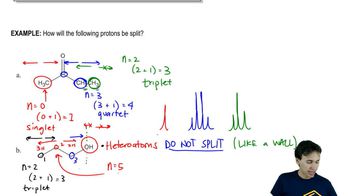
Proton Splitting

Acidity and Basicity

Acidity and basicity are fundamental concepts in organic chemistry that describe the tendency of a substance to donate or accept protons, respectively. The strength of an acid is determined by its ability to donate protons, while a base is characterized by its ability to accept protons. Understanding the relative acidity and basicity of functional groups in a compound is crucial for predicting which atom is most likely to be protonated.
Video consigliato:
06:21
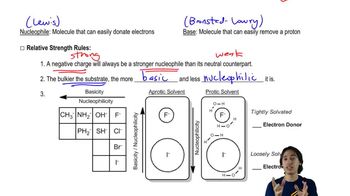
Understanding the difference between basicity and nucleophilicity.

Resonance Stabilization

Resonance stabilization refers to the delocalization of electrons across multiple atoms in a molecule, which can enhance stability. When considering protonation, atoms that can participate in resonance often become more favorable sites for protonation because the resulting positive charge can be distributed over several atoms, reducing the energy of the protonated species. This concept is essential for predicting the most likely site of protonation in complex organic molecules.
Video consigliato:
03:43
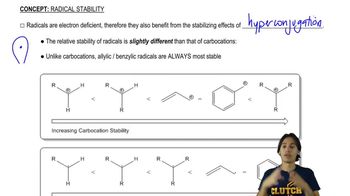
The radical stability trend.
Pratica correlata
Domanda del libro di testo

Tenormin, a member of the group of drugs known as beta-blockers, is used to treat high blood pressure and improve survival after a heart attack. It works by slowing down the heart to reduce its workload. Which atom in Tenormin is the most basic?

1136
views
Domanda del libro di testo

Rank the following alcohols from strongest to weakest acid.

CH2═CHCH2OH; CH3CH2CH2OH; HC≡CCH2OH

1770
views
Domanda del libro di testo

Explain the relative acidities.

CH2═CHCH2OH, CH3CH2CH2OH, HC≡CCH2OH

1624
views
Domanda del libro di testo

b. Determine the exact pKa values, using a calculator.

c. Which is the strongest acid?

1. nitrous acid (HNO2), Ka = 4.0 × 10⁻⁴

2. nitric acid (HNO3), Ka = 22

3. bicarbonate (HCO3−), Ka = 6.3 × 10⁻¹¹

4. hydrogen cyanide (HCN), Ka = 7.9 × 10⁻¹⁰

5. formic acid (HCOOH), Ka = 2.0 × 10⁻⁴

6. phosphoric acid (H3PO4), Ka = 2.1

1527
views
Domanda del libro di testo

A single bond between two carbons with different hybridizations has a small dipole. What is the direction of the dipole in the indicated bonds?

a.

b.

1811
views
Domanda del libro di testo

Given the Ka values, estimate the pKa value of each of the following acids without using a calculator (that is, is it between 3 and 4, between 9 and 10, and so on?):

1. nitrous acid (HNO2), Ka = 4.0 × 10⁻⁴

2. nitric acid (HNO3), Ka = 22

3. bicarbonate (HCO3−), Ka = 6.3 × 10⁻¹¹

4. hydrogen cyanide (HCN), Ka = 7.9 × 10⁻¹⁰

5. formic acid (HCOOH), Ka = 2.0 × 10⁻⁴

6. phosphoric acid (H3PO4), Ka = 2.1

3087
views