Ch. 22 - Catalysis in Organic Reactions and in Enzymatic Reactions
Bruice - Organic Chemistry 8th Edition
Bruice8th EditionOrganic ChemistryISBN: 9780135213711Non è quello che usi tu?Cambia libro di testo
Capitolo 22, Problema 27

In glycolysis, why must glucose-6-phosphate isomerize to fructose-6-phosphate (Section 22.12 ) before the cleavage reaction with aldolase occurs?

Guida verificata passo dopo passo
1
Understand the context: Glycolysis is a metabolic pathway that breaks down glucose into pyruvate, generating energy. The isomerization of glucose-6-phosphate (G6P) to fructose-6-phosphate (F6P) is a key step in this pathway.
Recognize the structural difference: Glucose-6-phosphate is a six-membered ring (a pyranose), while fructose-6-phosphate is a five-membered ring (a furanose). This structural change is necessary for subsequent reactions.
Identify the cleavage reaction: The aldolase enzyme cleaves fructose-1,6-bisphosphate (a derivative of F6P) into two three-carbon molecules: dihydroxyacetone phosphate (DHAP) and glyceraldehyde-3-phosphate (G3P). This reaction requires a ketose sugar (like fructose) rather than an aldose sugar (like glucose).
Explain the need for isomerization: The isomerization step converts G6P (an aldose) into F6P (a ketose), which is essential for the aldolase enzyme to recognize and cleave the molecule efficiently. Without this isomerization, the cleavage reaction would not proceed correctly.
Conclude the importance: The isomerization ensures that the glycolytic pathway progresses smoothly by preparing the molecule for the aldolase-catalyzed cleavage, which is a critical step in energy production.

Risposta video verificata per un problema simile:

Questa soluzione video è stata consigliata dai nostri tutor come utile per risolvere questo problema.
Durata del video:
5m

Concetti chiave

Ecco i concetti essenziali che devi comprendere per rispondere correttamente alla domanda.

Glycolysis

Glycolysis is a metabolic pathway that converts glucose into pyruvate, producing ATP and NADH in the process. It consists of ten enzyme-catalyzed reactions and is crucial for cellular respiration. Understanding glycolysis is essential for grasping how glucose is processed in cells and the significance of each intermediate formed during the pathway.
Video consigliato:
Percorso guidato
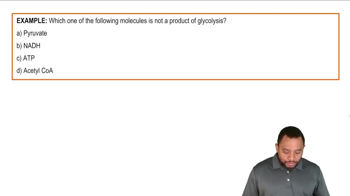
1:07
Intro to Glycolysis Example 1

Isomerization

Isomerization is a chemical process where a molecule is transformed into another molecule with the same atoms but in a different arrangement. In glycolysis, glucose-6-phosphate isomerizes to fructose-6-phosphate, which is necessary for the subsequent cleavage by aldolase. This rearrangement facilitates the formation of two three-carbon molecules, which is essential for efficient energy extraction.
Video consigliato:
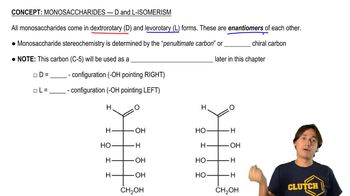
06:47
Monosaccharides - D and L Isomerism

Aldolase Reaction

The aldolase reaction is a key step in glycolysis where fructose-1,6-bisphosphate is cleaved into two three-carbon sugars: dihydroxyacetone phosphate and glyceraldehyde-3-phosphate. This reaction is crucial for the continuation of glycolysis, as it allows for the further breakdown of sugars to generate energy. The isomerization to fructose-6-phosphate ensures that the aldolase enzyme can effectively catalyze this cleavage.
Video consigliato:
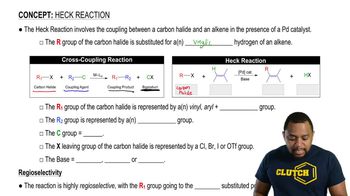
05:09
Heck Reaction