Indietro
 Blitzer 3rd EditionCh. 2 - Graphs of the Trigonometric Functions; Inverse Trigonometric Functions
Problema 55
In Exercises 55–62, use the properties of inverse functions f(f⁻¹ (x)) = x for all x in the domain of f⁻¹ and f⁻¹(f(x)) for all x in the domain of f, as well as the definitions of the inverse cotangent, cosecant, and secant functions, to find the exact value of each expression, if possible. cot(cot⁻¹ 9π)
Problema 57
In Exercises 55–62, use the properties of inverse functions f(f⁻¹ (x)) = x for all x in the domain of f⁻¹ and f⁻¹(f(x)) for all x in the domain of f, as well as the definitions of the inverse cotangent, cosecant, and secant functions, to find the exact value of each expression, if possible. sec(sec⁻¹ 7π)
Problema 59
In Exercises 55–62, use the properties of inverse functions f(f⁻¹ (x)) = x for all x in the domain of f⁻¹ and f⁻¹(f(x)) for all x in the domain of f, as well as the definitions of the inverse cotangent, cosecant, and secant functions, to find the exact value of each expression, if possible. cot⁻¹ (cot 3π/4)
Problema 63
In Exercises 63–82, use a sketch to find the exact value of each expression. cos (sin⁻¹ 4/5)
Problema 65
In Exercises 63–82, use a sketch to find the exact value of each expression. tan (cos⁻¹ 5/13)
Problema 67
In Exercises 63–82, use a sketch to find the exact value of each expression. tan [sin⁻¹ (− 3/5)]
Problema 69
In Exercises 63–82, use a sketch to find the exact value of each expression. _ sin (cos⁻¹ √2/2)
Problema 73
In Exercises 63–82, use a sketch to find the exact value of each expression. tan [cos⁻¹ (− 1/3)]
Problema 77
In Exercises 63–82, use a sketch to find the exact value of each expression. cos [tan⁻¹ (− 2/3)]
Problema 80
In Exercises 63–82, use a sketch to find the exact value of each expression. cot (csc⁻¹ 8)
Problema 83
In Exercises 83–94, use a right triangle to write each expression as an algebraic expression. Assume that x is positive and that the given inverse trigonometric function is defined for the expression in x. tan (cos⁻¹ x)
Problema 84
In Exercises 83–94, use a right triangle to write each expression as an algebraic expression. Assume that x is positive and that the given inverse trigonometric function is defined for the expression in x. sin (tan⁻¹ x)
Problema 87
In Exercises 83–94, use a right triangle to write each expression as an algebraic expression. Assume that x is positive and that the given inverse trigonometric function is defined for the expression in x. cos (sin⁻¹ 1/x)
Problema 88
In Exercises 83–94, use a right triangle to write each expression as an algebraic expression. Assume that x is positive and that the given inverse trigonometric function is defined for the expression in x. sec (cos⁻¹ 1/x)
Problema 91
In Exercises 83–94, use a right triangle to write each expression as an algebraic expression. Assume that x is positive and that the given inverse trigonometric function is defined for the expression in x. ___ sec (sin⁻¹ x/√x²+4)
Problema 94
In Exercises 83–94, use a right triangle to write each expression as an algebraic expression. Assume that x is positive and that the given inverse trigonometric function is defined for the expression in x. csc (cot⁻¹ x)
Problema 97
The graphs of y = sin⁻¹ x, y = cos⁻¹ x, and y = tan⁻¹ x are shown in Table 2.8. In Exercises 97–106, use transformations (vertical shifts, horizontal shifts, reflections, stretching, or shrinking) of these graphs to graph each function. Then use interval notation to give the function's domain and range. f(x) = sin⁻¹ x + π/2
Problema 99
The graphs of y = sin⁻¹ x, y = cos⁻¹ x, and y = tan⁻¹ x are shown in Table 2.8. In Exercises 97–106, use transformations (vertical shifts, horizontal shifts, reflections, stretching, or shrinking) of these graphs to graph each function. Then use interval notation to give the function's domain and range. f(x) = cos⁻¹ (x + 1)
Problema 101
The graphs of y = sin⁻¹ x, y = cos⁻¹ x, and y = tan⁻¹ x are shown in Table 2.8. In Exercises 97–106, use transformations (vertical shifts, horizontal shifts, reflections, stretching, or shrinking) of these graphs to graph each function. Then use interval notation to give the function's domain and range. h(x) = −2 tan⁻¹ x
Problema 105
The graphs of y = sin⁻¹ x, y = cos⁻¹ x, and y = tan⁻¹ x are shown in Table 2.8. In Exercises 97–106, use transformations (vertical shifts, horizontal shifts, reflections, stretching, or shrinking) of these graphs to graph each function. Then use interval notation to give the function's domain and range. f(x) = cos⁻¹ x/2
Problema 1
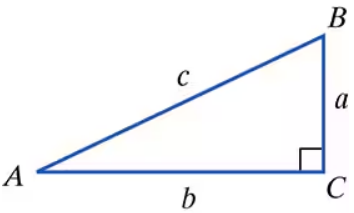
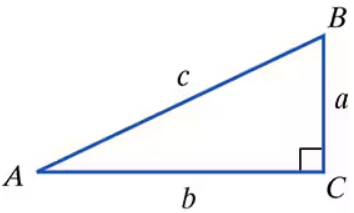
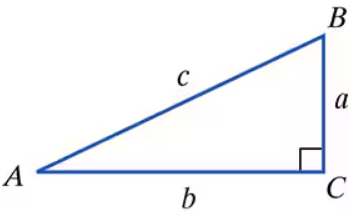
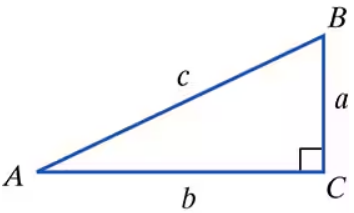
Solve the right triangle shown in the figure. Round lengths to two decimal places and express angles to the nearest tenth of a degree. A = 23.5°, b = 10
Problema 3
Solve the right triangle shown in the figure. Round lengths to two decimal places and express angles to the nearest tenth of a degree. A = 52.6°, c = 54
Problema 5
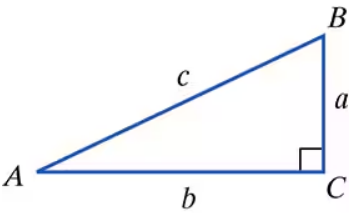
Solve the right triangle shown in the figure. Round lengths to two decimal places and express angles to the nearest tenth of a degree. B = 16.8°, b = 30.5
Problema 7
Solve the right triangle shown in the figure. Round lengths to two decimal places and express angles to the nearest tenth of a degree. a = 30.4, c = 50.2
Problema 9
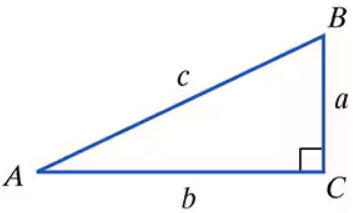
Solve the right triangle shown in the figure. Round lengths to two decimal places and express angles to the nearest tenth of a degree. a = 10.8, b = 24.7
Problema 11
Solve the right triangle shown in the figure. Round lengths to two decimal places and express angles to the nearest tenth of a degree. b = 2, c = 7
Problema 13
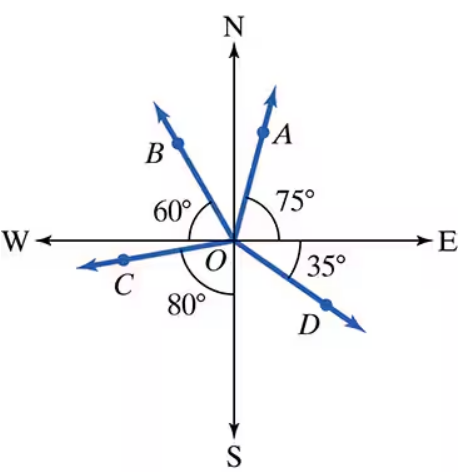
Find the bearing from O to A.
Problema 22
In Exercises 21–28, an object moves in simple harmonic motion described by the given equation, where t is measured in seconds and d in inches. In each exercise, find the following: a. the maximum displacement b. the frequency c. the time required for one cycle. d = 10 cos 2πt
Problema 24
In Exercises 21–28, an object moves in simple harmonic motion described by the given equation, where t is measured in seconds and d in inches. In each exercise, find the following: a. the maximum displacement b. the frequency c. the time required for one cycle. d = −8 cos π/2 t
Problema 26
In Exercises 21–28, an object moves in simple harmonic motion described by the given equation, where t is measured in seconds and d in inches. In each exercise, find the following: a. the maximum displacement b. the frequency c. the time required for one cycle. d = 1/3 sin 2t