Ch. 2 The Chemical Level of Organization
Martini - Fundamentals of Anatomy & Physiology 11th Edition
Martini, Nath, Bartholomew11th EditionFundamentals of Anatomy & PhysiologyISBN: 9780136874089당신이 사용하는 게 아니라요?교과서 변경
2장, 문제 15

Complementary base pairing in DNA includes the pairs
(a) Adenine–uracil and cytosine–guanine
(b) Adenine–thymine and cytosine–guanine
(c) Adenine–guanine and cytosine–thymine
(d) Guanine–uracil and cytosine–thymine

검증된 단계별 안내
1
Step 1: Understand the concept of complementary base pairing in DNA. DNA is composed of four nitrogenous bases: adenine (A), thymine (T), cytosine (C), and guanine (G). These bases pair specifically to maintain the double helix structure.
Step 2: Recall the base pairing rules in DNA. Adenine always pairs with thymine, and cytosine always pairs with guanine. This is due to hydrogen bonding compatibility between these bases.
Step 3: Note that uracil (U) is not found in DNA; it is present in RNA instead, where it pairs with adenine. Therefore, any option including uracil as a DNA base pair can be excluded.
Step 4: Evaluate each option based on these rules: (a) includes uracil, so it is incorrect; (b) adenine–thymine and cytosine–guanine matches the correct DNA base pairing; (c) adenine–guanine and cytosine–thymine are incorrect pairings; (d) guanine–uracil and cytosine–thymine are incorrect and include uracil.
Step 5: Conclude that the correct complementary base pairs in DNA are adenine–thymine and cytosine–guanine, corresponding to option (b).

비슷한 문제에 대한 검증된 영상 답변:

이 영상 해법은 위 문제에 도움이 된다고 튜터들이 추천한 것입니다.
영상 길이:
2m

주요 개념

질문에 올바르게 답하기 위해 반드시 이해해야 하는 핵심 개념들은 다음과 같습니다.

Complementary Base Pairing in DNA

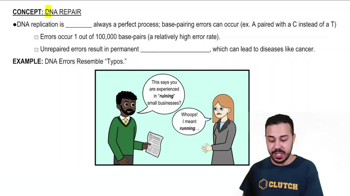
Complementary base pairing refers to the specific hydrogen bonding between nitrogenous bases in DNA. Adenine (A) pairs with thymine (T) via two hydrogen bonds, and cytosine (C) pairs with guanine (G) via three hydrogen bonds, ensuring the DNA double helix's stability and accurate replication.
추천 영상:

Difference Between DNA and RNA Bases

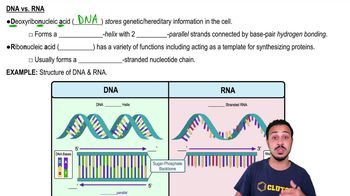
DNA and RNA differ in one key base: DNA contains thymine (T), while RNA contains uracil (U) instead. This distinction is crucial because adenine pairs with thymine in DNA but pairs with uracil in RNA, affecting base pairing rules depending on the nucleic acid type.
추천 영상:

Structure and Function of Nitrogenous Bases

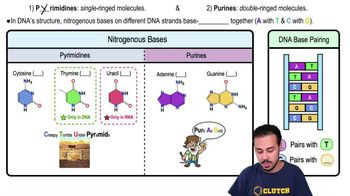
Nitrogenous bases are categorized as purines (adenine and guanine) and pyrimidines (cytosine, thymine, and uracil). Purines pair with pyrimidines to maintain uniform DNA structure; mismatched pairs like adenine–guanine or cytosine–thymine disrupt the double helix and are not found in normal base pairing.
추천 영상:
가이드 코스
07:21
5 Nitrogenous Bases