Ch. 2 The Chemical Level of Organization
Martini - Fundamentals of Anatomy & Physiology 11th Edition
Martini, Nath, Bartholomew11th EditionFundamentals of Anatomy & PhysiologyISBN: 9780136874089당신이 사용하는 게 아니라요?교과서 변경
2장, 문제 16

What are the three subatomic particles in atoms?

검증된 단계별 안내
1
Understand that atoms are composed of smaller particles called subatomic particles, which determine the atom's properties and behavior.
Identify the three main types of subatomic particles: protons, neutrons, and electrons.
Recognize that protons carry a positive electrical charge and are located in the nucleus (center) of the atom.
Know that neutrons have no electrical charge (they are neutral) and are also found in the nucleus alongside protons.
Understand that electrons carry a negative electrical charge and orbit the nucleus in regions called electron shells or clouds.

비슷한 문제에 대한 검증된 영상 답변:

이 영상 해법은 위 문제에 도움이 된다고 튜터들이 추천한 것입니다.
영상 길이:
1m
도움이 되었나요?

주요 개념

질문에 올바르게 답하기 위해 반드시 이해해야 하는 핵심 개념들은 다음과 같습니다.

Protons

Protons are positively charged subatomic particles found in the nucleus of an atom. They determine the atomic number and identity of an element. Each proton carries a charge of +1 and contributes to the overall mass of the atom.
추천 영상:
가이드 코스
01:43
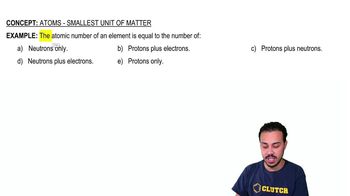
Atoms- Smallest Unit of Matter Example 2

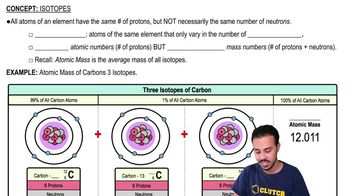
Neutrons

Neutrons are neutral subatomic particles located in the nucleus alongside protons. They have no electric charge and contribute to the atomic mass. Neutrons play a key role in stabilizing the nucleus by offsetting the repulsive forces between protons.
추천 영상:

Electrons

Electrons are negatively charged subatomic particles that orbit the nucleus in electron shells. Each electron carries a charge of -1 and has negligible mass compared to protons and neutrons. Electrons are involved in chemical bonding and reactions.
추천 영상:
가이드 코스
07:41
Electron Transport Chain