Ch. 20 The Heart
Martini - Fundamentals of Anatomy & Physiology 11th Edition
Martini, Nath, Bartholomew11th EditionFundamentals of Anatomy & PhysiologyISBN: 9780136874089당신이 사용하는 게 아니라요?교과서 변경
20장, 문제 28

Vern is suffering from cardiac arrhythmias and is brought into the emergency room of a hospital. In the emergency room he begins to exhibit tachycardia and as a result loses consciousness. Explain why Vern lost consciousness.

검증된 단계별 안내
1
Step 1: Understand the terms involved. Tachycardia is a condition where the heart beats faster than normal, typically over 100 beats per minute in adults. Cardiac arrhythmias refer to irregular heart rhythms, which can affect how effectively the heart pumps blood.
Step 2: Recognize the relationship between heart rate and cardiac output. Cardiac output (CO) is the volume of blood the heart pumps per minute and is calculated as \(CO = HR \times SV\), where \(HR\) is heart rate and \(SV\) is stroke volume (the amount of blood pumped with each beat).
Step 3: Consider how tachycardia affects stroke volume. When the heart beats too fast, the ventricles have less time to fill with blood during diastole, which reduces stroke volume. Even though heart rate increases, the decrease in stroke volume can lead to a reduced or insufficient cardiac output.
Step 4: Connect cardiac output to brain perfusion. The brain requires a constant and adequate supply of oxygenated blood. If cardiac output drops significantly, less blood reaches the brain, leading to decreased oxygen delivery.
Step 5: Explain loss of consciousness. Due to reduced cerebral perfusion from decreased cardiac output during tachycardia, the brain does not receive enough oxygen, causing Vern to lose consciousness.

비슷한 문제에 대한 검증된 영상 답변:

이 영상 해법은 위 문제에 도움이 된다고 튜터들이 추천한 것입니다.
도움이 되었나요?

주요 개념

질문에 올바르게 답하기 위해 반드시 이해해야 하는 핵심 개념들은 다음과 같습니다.

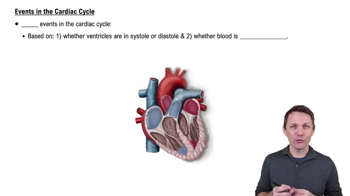
Cardiac Arrhythmias

Cardiac arrhythmias are irregularities in the heart's rhythm, which can cause the heart to beat too fast, too slow, or erratically. These disruptions affect the heart's ability to pump blood efficiently, potentially leading to inadequate blood flow to vital organs.
추천 영상:
9:44
Events in the Cardiac Cycle

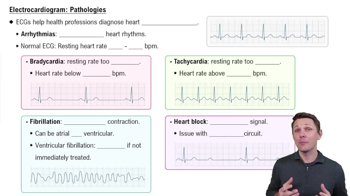
Tachycardia

Tachycardia is a condition where the heart rate exceeds the normal resting rate, typically over 100 beats per minute. While it may initially increase cardiac output, sustained tachycardia can reduce the heart's filling time, decreasing stroke volume and overall blood circulation.
추천 영상:
9:24
Electrocardiogram: Pathologies

Loss of Consciousness Due to Reduced Cerebral Perfusion

Loss of consciousness occurs when the brain does not receive enough oxygen-rich blood, a state called cerebral hypoperfusion. In tachycardia caused by arrhythmias, inefficient heart pumping reduces blood flow to the brain, leading to fainting or syncope.
추천 영상:
4:49
Functional Areas of the Cerebral Cortex