Ch. 20 The Heart
Martini - Fundamentals of Anatomy & Physiology 11th Edition
Martini, Nath, Bartholomew11th EditionFundamentals of Anatomy & PhysiologyISBN: 9780136874089당신이 사용하는 게 아니라요?교과서 변경
20장, 문제 26

What effect does sympathetic stimulation have on the heart? What effect does parasympathetic stimulation have on the heart?

검증된 단계별 안내
1
Step 1: Understand the autonomic nervous system's role in regulating heart function. The sympathetic and parasympathetic divisions have opposite effects on the heart to maintain homeostasis.
Step 2: Recognize that sympathetic stimulation increases heart rate and force of contraction. This occurs because sympathetic nerves release norepinephrine, which binds to beta-1 adrenergic receptors on cardiac muscle cells.
Step 3: Note that sympathetic stimulation also increases the speed of electrical conduction through the heart, particularly at the sinoatrial (SA) node and atrioventricular (AV) node, leading to a faster heartbeat.
Step 4: Understand that parasympathetic stimulation decreases heart rate by releasing acetylcholine, which acts on muscarinic receptors in the SA and AV nodes, slowing the rate of depolarization and conduction.
Step 5: Summarize that parasympathetic stimulation primarily reduces heart rate without significantly affecting the force of contraction, promoting a state of rest and energy conservation.

비슷한 문제에 대한 검증된 영상 답변:

이 영상 해법은 위 문제에 도움이 된다고 튜터들이 추천한 것입니다.
도움이 되었나요?

주요 개념

질문에 올바르게 답하기 위해 반드시 이해해야 하는 핵심 개념들은 다음과 같습니다.

Sympathetic Nervous System and Cardiac Function

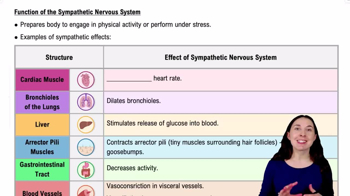
The sympathetic nervous system increases heart rate and force of contraction by releasing norepinephrine, which binds to beta-1 adrenergic receptors on cardiac cells. This prepares the body for 'fight or flight' responses by enhancing cardiac output and blood flow to muscles.
추천 영상:
2:52
Function of the Sympathetic Nervous System

Parasympathetic Nervous System and Cardiac Function

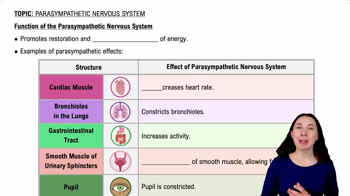
The parasympathetic nervous system decreases heart rate by releasing acetylcholine, which acts on muscarinic receptors in the heart, primarily the sinoatrial node. This promotes 'rest and digest' activities by slowing the heart rate and conserving energy.
추천 영상:
1:56
Function of the Parasympathetic Nervous System

Autonomic Regulation of Heart Rate

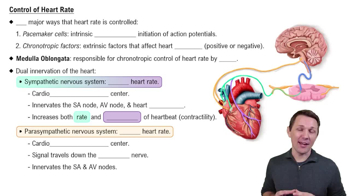
Heart rate is regulated by the balance between sympathetic and parasympathetic inputs to the sinoatrial node. Sympathetic stimulation accelerates heart rate, while parasympathetic stimulation slows it, allowing the body to adapt to varying physiological demands.
추천 영상:
가이드 코스
6:13
Control of Heart Rate