Ch.10 Acids and Bases
McMurry - Fundamentals of General, Organic, and Biological Chemistry 8th Edition
McMurry8th EditionFundamentals of General, Organic, and Biological ChemistryISBN: 9780134015187당신이 사용하는 게 아니라요?교과서 변경
10장, 문제 83

How does normality compare to molarity for monoprotic and polyprotic acids?

검증된 단계별 안내
1
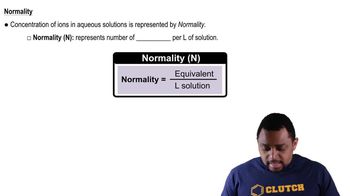
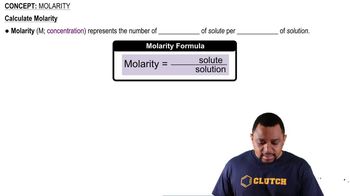
Understand the definitions: Molarity (M) is the number of moles of solute per liter of solution, while Normality (N) is the number of equivalents of solute per liter of solution. An equivalent depends on the reaction being studied, such as the number of protons (H⁺) an acid can donate.
For monoprotic acids (e.g., HCl): Each molecule of the acid donates one proton (H⁺) in a reaction. Therefore, the number of equivalents is equal to the number of moles. In this case, Normality (N) is equal to Molarity (M).
For polyprotic acids (e.g., H₂SO₄): Each molecule of the acid can donate more than one proton (H⁺). For example, sulfuric acid (H₂SO₄) can donate two protons. In this case, the Normality (N) is equal to the Molarity (M) multiplied by the number of protons the acid can donate. Mathematically, N = M × number of protons donated.
To calculate Normality for a polyprotic acid, identify the number of protons the acid can donate in the reaction. For example, if 1 M H₂SO₄ is fully dissociated, it will have a Normality of 2 N because it donates 2 protons per molecule.
Summarize the relationship: For monoprotic acids, Normality equals Molarity (N = M). For polyprotic acids, Normality is greater than Molarity and is calculated as N = M × number of protons donated.

비슷한 문제에 대한 검증된 영상 답변:

이 영상 해법은 위 문제에 도움이 된다고 튜터들이 추천한 것입니다.
영상 길이:
3m
도움이 되었나요?

주요 개념

질문에 올바르게 답하기 위해 반드시 이해해야 하는 핵심 개념들은 다음과 같습니다.

Normality

Normality is a measure of concentration equivalent to the number of equivalents of solute per liter of solution. It is particularly useful in acid-base reactions, where it accounts for the reactive capacity of an acid or base. For monoprotic acids, which donate one proton per molecule, normality equals molarity. However, for polyprotic acids, which can donate multiple protons, normality can be greater than molarity, reflecting the total number of protons available for reaction.
추천 영상:
가이드 코스
00:31
Equivalents Concept 2

Molarity

Molarity is defined as the number of moles of solute per liter of solution. It is a fundamental unit of concentration in chemistry, allowing for the quantification of solute in a given volume. Molarity does not consider the reactivity of the solute, making it a straightforward measure for solutions. In the context of acids, molarity provides a basis for understanding the concentration of the acid itself, regardless of its ability to donate protons.
추천 영상:

Monoprotic vs. Polyprotic Acids

Monoprotic acids are acids that can donate only one proton (H+) per molecule, such as hydrochloric acid (HCl). In contrast, polyprotic acids can donate more than one proton; for example, sulfuric acid (H2SO4) can donate two protons. This distinction is crucial when comparing normality and molarity, as the normality of polyprotic acids can be significantly higher than their molarity due to the multiple protons they can release in solution.
추천 영상:
가이드 코스
3:33
Enantiomers vs Diastereomers Concept 1