Ch.10 Acids and Bases
McMurry - Fundamentals of General, Organic, and Biological Chemistry 8th Edition
McMurry8th EditionFundamentals of General, Organic, and Biological ChemistryISBN: 9780134015187당신이 사용하는 게 아니라요?교과서 변경
10장, 문제 90

What are the molarity and the normality of a solution made by dissolving 5.0 g of Ca(OH)2 in enough water to make 500.0 mL of solution?

검증된 단계별 안내
1
Step 1: Calculate the molar mass of calcium hydroxide (Ca(OH)₂). The molar mass is determined by summing the atomic masses of all atoms in the compound: Ca = 40.08 g/mol, O = 16.00 g/mol, H = 1.008 g/mol. Therefore, the molar mass of Ca(OH)₂ is 40.08 + (2 × (16.00 + 1.008)) g/mol.
Step 2: Convert the given mass of Ca(OH)₂ (5.0 g) into moles using the formula: \( \text{moles} = \frac{\text{mass}}{\text{molar mass}} \). Substitute the values for mass and molar mass to find the number of moles of Ca(OH)₂.
Step 3: Calculate the molarity (M) of the solution using the formula: \( M = \frac{\text{moles of solute}}{\text{volume of solution in liters}} \). Convert the given volume of the solution (500.0 mL) into liters by dividing by 1000, then substitute the moles of Ca(OH)₂ and the volume in liters into the formula.
Step 4: Determine the normality (N) of the solution. For Ca(OH)₂, each molecule provides 2 hydroxide ions (OH⁻), so the equivalent factor is 2. Use the formula: \( N = M \times \text{equivalent factor} \). Multiply the molarity by the equivalent factor to find the normality.
Step 5: Summarize the results. The molarity represents the concentration of Ca(OH)₂ in moles per liter, while the normality accounts for the number of equivalents of hydroxide ions per liter of solution.

비슷한 문제에 대한 검증된 영상 답변:

이 영상 해법은 위 문제에 도움이 된다고 튜터들이 추천한 것입니다.
영상 길이:
3m
도움이 되었나요?

주요 개념

질문에 올바르게 답하기 위해 반드시 이해해야 하는 핵심 개념들은 다음과 같습니다.

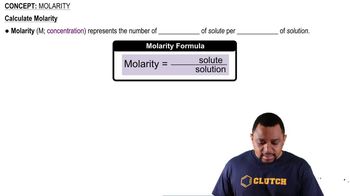
Molarity

Molarity is a measure of concentration defined as the number of moles of solute per liter of solution. It is calculated using the formula M = moles of solute / liters of solution. In this case, to find the molarity of the Ca(OH)₂ solution, one must first convert the mass of the solute into moles using its molar mass and then divide by the volume of the solution in liters.
추천 영상:

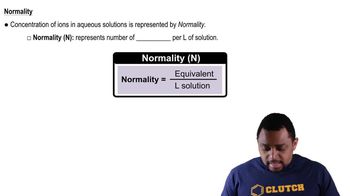
Normality

Normality is another measure of concentration that reflects the number of equivalents of a solute per liter of solution. It is particularly useful in acid-base reactions and redox reactions. For Ca(OH)₂, which can donate two hydroxide ions (OH⁻) per formula unit, the normality can be calculated by multiplying the molarity by the number of equivalents, which is determined by the number of reactive species in the solution.
추천 영상:
가이드 코스
00:31
Equivalents Concept 2

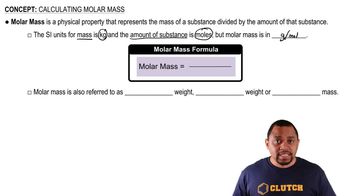
Molar Mass

Molar mass is the mass of one mole of a substance, typically expressed in grams per mole (g/mol). It is essential for converting between grams and moles when calculating concentrations. For Ca(OH)₂, the molar mass is calculated by summing the atomic masses of calcium (Ca), oxygen (O), and hydrogen (H) in the compound, which is necessary to determine how many moles are present in the given mass of the solute.
추천 영상:
가이드 코스
01:10
Calculating Molar Mass