Ch.4 Molecular Compounds
McMurry - Fundamentals of General, Organic, and Biological Chemistry 8th Edition
McMurry8th EditionFundamentals of General, Organic, and Biological ChemistryISBN: 9780134015187당신이 사용하는 게 아니라요?교과서 변경
4장, 문제 93

The sulfite ion (SO32–) and sulfur trioxide (SO3) have the same chemical formulas but different molecular geometries. Draw the Lewis dot structures and identify the molecular geometry of each.

검증된 단계별 안내
1
Step 1: Begin by determining the total number of valence electrons for each species. For the sulfite ion (SO₃²⁻), sulfur contributes 6 electrons, each oxygen contributes 6 electrons, and the ion has an additional 2 electrons due to its charge. For sulfur trioxide (SO₃), sulfur contributes 6 electrons, and each oxygen contributes 6 electrons, with no extra electrons from charge.
Step 2: Draw the Lewis dot structure for the sulfite ion (SO₃²⁻). Place sulfur in the center as the least electronegative atom, and arrange the three oxygen atoms around it. Distribute the valence electrons to satisfy the octet rule for each atom, keeping in mind the extra 2 electrons from the charge. Include resonance structures if applicable.
Step 3: Draw the Lewis dot structure for sulfur trioxide (SO₃). Place sulfur in the center and arrange the three oxygen atoms around it. Distribute the valence electrons to satisfy the octet rule for each atom. Note that sulfur can expand its octet due to its position in Period 3 of the periodic table. Include resonance structures if applicable.
Step 4: Identify the molecular geometry of the sulfite ion (SO₃²⁻) using VSEPR theory. Count the regions of electron density (bonding pairs and lone pairs) around the central sulfur atom. The presence of lone pairs will affect the geometry, resulting in a trigonal pyramidal shape.
Step 5: Identify the molecular geometry of sulfur trioxide (SO₃) using VSEPR theory. Count the regions of electron density around the central sulfur atom. Since there are no lone pairs on sulfur, the geometry will be trigonal planar.

비슷한 문제에 대한 검증된 영상 답변:

이 영상 해법은 위 문제에 도움이 된다고 튜터들이 추천한 것입니다.
영상 길이:
7m
도움이 되었나요?

주요 개념

질문에 올바르게 답하기 위해 반드시 이해해야 하는 핵심 개념들은 다음과 같습니다.

Lewis Dot Structures

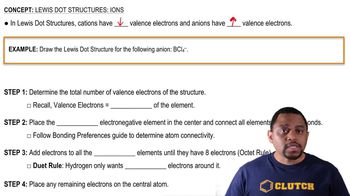
Lewis dot structures are diagrams that represent the valence electrons of atoms within a molecule. They illustrate how electrons are shared or transferred between atoms, helping to visualize bonding and lone pairs. For the sulfite ion (SO₃²⁻) and sulfur trioxide (SO₃), drawing their Lewis structures will reveal the arrangement of electrons and the connectivity of atoms.
추천 영상:
가이드 코스
03:11
Lewis Dot Structures: Ions (Simplified) Concept 1

Molecular Geometry

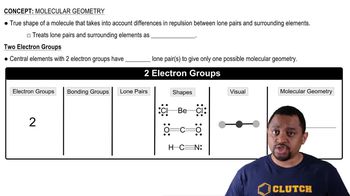
Molecular geometry refers to the three-dimensional arrangement of atoms in a molecule. It is determined by the number of bonding pairs and lone pairs of electrons around the central atom, which influences the shape of the molecule. Understanding the molecular geometry of SO₃²⁻ and SO₃ is crucial for predicting their chemical behavior and reactivity.
추천 영상:
가이드 코스
01:30
Molecular Geometry (Simplified) Concept 1

VSEPR Theory

Valence Shell Electron Pair Repulsion (VSEPR) theory is a model used to predict the geometry of molecules based on the repulsion between electron pairs. According to VSEPR, electron pairs will arrange themselves to minimize repulsion, leading to specific molecular shapes. This theory is essential for determining the molecular geometries of SO₃²⁻ and SO₃ after constructing their Lewis dot structures.
추천 영상: