
Ch.4 Molecular Compounds
McMurry - Fundamentals of General, Organic, and Biological Chemistry 8th Edition
McMurry8th EditionFundamentals of General, Organic, and Biological ChemistryISBN: 9780134015187당신이 사용하는 게 아니라요?교과서 변경
4장, 문제 89a

Which of the following compounds contain ionic bonds? Which contain covalent bonds? Which contain coordinate covalent bonds? (A compound may contain more than one type of bond.)
a. BaCl2

검증된 단계별 안내
1
Step 1: Understand the types of chemical bonds. Ionic bonds occur between metals and nonmetals where electrons are transferred. Covalent bonds occur between nonmetals where electrons are shared. Coordinate covalent bonds occur when one atom provides both electrons in a shared pair.
Step 2: Analyze the compound BaCl₂. Barium (Ba) is a metal, and chlorine (Cl) is a nonmetal. This suggests the presence of ionic bonds due to the transfer of electrons from Ba to Cl.
Step 3: Determine if covalent bonds are present. In BaCl₂, chlorine atoms do not share electrons with each other, so covalent bonds are not present.
Step 4: Evaluate the possibility of coordinate covalent bonds. Coordinate covalent bonds typically occur in compounds with complex structures, such as metal complexes. BaCl₂ does not exhibit this type of bonding.
Step 5: Conclude that BaCl₂ contains ionic bonds only, as the bonding involves the transfer of electrons from the metal (Ba) to the nonmetal (Cl).

비슷한 문제에 대한 검증된 영상 답변:

이 영상 해법은 위 문제에 도움이 된다고 튜터들이 추천한 것입니다.
영상 길이:
4m
도움이 되었나요?

주요 개념

질문에 올바르게 답하기 위해 반드시 이해해야 하는 핵심 개념들은 다음과 같습니다.

Ionic Bonds

Ionic bonds are formed when one atom donates an electron to another, resulting in the creation of charged ions. These oppositely charged ions attract each other, creating a strong electrostatic force that holds them together. Common examples include compounds formed between metals and nonmetals, such as sodium chloride (NaCl) and barium chloride (BaCl₂).
추천 영상:
가이드 코스
02:33
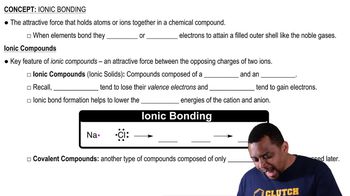
Ionic Bonding Concept 1

Covalent Bonds

Covalent bonds occur when two atoms share one or more pairs of electrons, allowing each atom to attain a stable electron configuration. This type of bond typically forms between nonmetals and can result in the creation of molecules like water (H₂O) or carbon dioxide (CO₂). The strength of covalent bonds can vary based on the number of shared electron pairs.
추천 영상:
가이드 코스
01:04
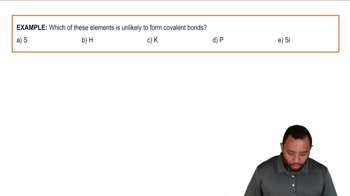
Covalent Bonds Example 1

Coordinate Covalent Bonds

Coordinate covalent bonds, also known as dative bonds, occur when one atom donates both electrons to a bond, while the other atom does not contribute any electrons. This type of bond is often found in complex ions and coordination compounds, such as ammonium ion (NH₄⁺) where nitrogen donates a lone pair to bond with a hydrogen ion (H⁺).
추천 영상:
가이드 코스
01:04
Covalent Bonds Example 1