Ch.7 Chemical Reactions: Energy, Rate and Equilibrium
McMurry - Fundamentals of General, Organic, and Biological Chemistry 8th Edition
McMurry8th EditionFundamentals of General, Organic, and Biological ChemistryISBN: 9780134015187당신이 사용하는 게 아니라요?교과서 변경
7장, 문제 27b

Acetylene (H–C≡C–H) is the fuel used in welding torches.
b. Estimate ∆H for this reaction (in kJ/mol) using the bond energies listed in Table 7.1.

검증된 단계별 안내
1
Identify the bonds present in the reactants and products. In acetylene (H―C≡C―H), there are two C―H bonds and one C≡C bond. For the products of combustion (CO₂ and H₂O), each CO₂ molecule has two C=O bonds, and each H₂O molecule has two O―H bonds.
Write the balanced chemical equation for the combustion of acetylene: 2C₂H₂ + 5O₂ → 4CO₂ + 2H₂O. This shows that 2 moles of acetylene react with 5 moles of oxygen to produce 4 moles of carbon dioxide and 2 moles of water.
Calculate the total bond energy of the bonds broken in the reactants. This includes the bond energies for 2 moles of acetylene (4 C―H bonds and 2 C≡C bonds) and 5 moles of O₂ (5 O=O bonds). Use the bond energy values from Table 7.1.
Calculate the total bond energy of the bonds formed in the products. This includes the bond energies for 4 moles of CO₂ (8 C=O bonds) and 2 moles of H₂O (4 O―H bonds). Use the bond energy values from Table 7.1.
Determine ∆H for the reaction by subtracting the total bond energy of the bonds formed (products) from the total bond energy of the bonds broken (reactants): ∆H = Σ(Bond energies of bonds broken) - Σ(Bond energies of bonds formed).

비슷한 문제에 대한 검증된 영상 답변:

이 영상 해법은 위 문제에 도움이 된다고 튜터들이 추천한 것입니다.
영상 길이:
10m
도움이 되었나요?

주요 개념

질문에 올바르게 답하기 위해 반드시 이해해야 하는 핵심 개념들은 다음과 같습니다.

Bond Energies

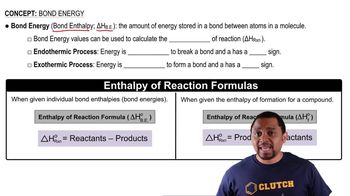
Bond energies represent the amount of energy required to break a bond between two atoms in a molecule. Each type of bond has a specific energy value, which can be found in tables. In the context of chemical reactions, the total bond energy of reactants is compared to that of products to estimate the overall change in enthalpy (∆H).
추천 영상:

Enthalpy Change (∆H)

Enthalpy change (∆H) is a measure of the heat content of a system during a chemical reaction at constant pressure. It indicates whether a reaction is exothermic (releases heat, ∆H < 0) or endothermic (absorbs heat, ∆H > 0). Calculating ∆H involves summing the bond energies of the reactants and subtracting the bond energies of the products.
추천 영상:
가이드 코스
01:17
Physical & Chemical Changes

Welding and Acetylene

Acetylene is a hydrocarbon commonly used as a fuel in welding torches due to its high flame temperature when burned with oxygen. Understanding the combustion of acetylene is essential for estimating the energy released during welding processes. The reaction involves breaking and forming bonds, which directly relates to the calculation of ∆H.
추천 영상:
가이드 코스
5:04
Amino Acid Catabolism: Carbon Atoms Concept 3