Ch.7 Chemical Reactions: Energy, Rate and Equilibrium
McMurry - Fundamentals of General, Organic, and Biological Chemistry 8th Edition
McMurry8th EditionFundamentals of General, Organic, and Biological ChemistryISBN: 9780134015187당신이 사용하는 게 아니라요?교과서 변경
7장, 문제 29c

Glucose, also known as "blood sugar" when measured in blood, has the formula C6H12O6.
c. What is the minimum amount of energy (in kJ) a plant must absorb to produce 15.0 g of glucose?

검증된 단계별 안내
1
Determine the molar mass of glucose (C₆H₁₂O₆) by summing the atomic masses of its constituent elements: Carbon (C), Hydrogen (H), and Oxygen (O). Use the periodic table to find the atomic masses: C = 12.01 g/mol, H = 1.008 g/mol, O = 16.00 g/mol. Calculate the molar mass as: Molar mass = (6 × 12.01) + (12 × 1.008) + (6 × 16.00).
Convert the given mass of glucose (15.0 g) into moles using the formula: \( \text{moles of glucose} = \frac{\text{mass of glucose}}{\text{molar mass of glucose}} \). Substitute the values for mass and molar mass from Step 1.
Recall the photosynthesis reaction: \( 6 \text{CO}_2 + 6 \text{H}_2\text{O} + \text{light energy} \rightarrow \text{C}_6\text{H}_{12}\text{O}_6 + 6 \text{O}_2 \). The energy required to produce 1 mole of glucose is approximately 2802 kJ.
Calculate the energy required to produce the moles of glucose determined in Step 2 using the formula: \( \text{energy required} = \text{moles of glucose} \times 2802 \ \text{kJ/mol} \).
Ensure the final energy value is expressed in kilojoules (kJ) and rounded appropriately based on significant figures from the given data (15.0 g of glucose).

비슷한 문제에 대한 검증된 영상 답변:

이 영상 해법은 위 문제에 도움이 된다고 튜터들이 추천한 것입니다.
영상 길이:
5m
도움이 되었나요?

주요 개념

질문에 올바르게 답하기 위해 반드시 이해해야 하는 핵심 개념들은 다음과 같습니다.

Photosynthesis

Photosynthesis is the biochemical process by which green plants, algae, and some bacteria convert light energy into chemical energy stored in glucose. This process primarily occurs in the chloroplasts of plant cells, using sunlight, carbon dioxide, and water to produce glucose and oxygen. Understanding photosynthesis is crucial for calculating the energy required for glucose production.

Energy Conversion

Energy conversion in the context of photosynthesis refers to the transformation of solar energy into chemical energy. The energy absorbed from sunlight is used to drive the endothermic reactions that synthesize glucose from carbon dioxide and water. This concept is essential for determining the minimum energy required for producing a specific mass of glucose.
추천 영상:
가이드 코스
03:45
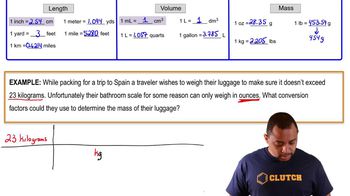
Conversion Factors (Simplified) Example 2

Molar Mass of Glucose

The molar mass of glucose (C6H12O6) is approximately 180.18 g/mol. This value is critical for converting grams of glucose into moles, which can then be used to calculate the energy required for its synthesis based on the energy per mole involved in the photosynthetic process. Accurate molar mass calculations are fundamental for stoichiometric conversions in chemistry.
추천 영상:
가이드 코스
01:10
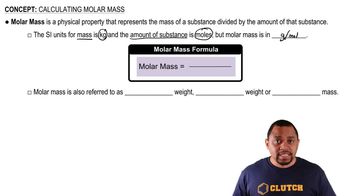
Calculating Molar Mass