Ch.7 Chemical Reactions: Energy, Rate and Equilibrium
McMurry - Fundamentals of General, Organic, and Biological Chemistry 8th Edition
McMurry8th EditionFundamentals of General, Organic, and Biological ChemistryISBN: 9780134015187당신이 사용하는 게 아니라요?교과서 변경
7장, 문제 31

Which of the following processes results in an increase in entropy of the system?
a. A drop of ink spreading out when it is placed in water
b. Steam condensing into drops on windows
c. Constructing a building from loose bricks

검증된 단계별 안내
1
Step 1: Understand the concept of entropy. Entropy is a measure of the disorder or randomness in a system. Processes that increase disorder or spread energy more evenly tend to increase entropy.
Step 2: Analyze option (a): A drop of ink spreading out in water. When ink disperses in water, the molecules of ink spread out and mix with water molecules, increasing the randomness of the system. This process increases entropy.
Step 3: Analyze option (b): Steam condensing into drops on windows. Condensation involves gas molecules (steam) transitioning to a liquid state, which is more ordered. This process decreases entropy.
Step 4: Analyze option (c): Constructing a building from loose bricks. Building a structure from disordered bricks creates a more ordered system, which decreases entropy.
Step 5: Conclude that the process in option (a) results in an increase in entropy because it involves the spreading out and mixing of molecules, leading to greater disorder in the system.

비슷한 문제에 대한 검증된 영상 답변:

이 영상 해법은 위 문제에 도움이 된다고 튜터들이 추천한 것입니다.
영상 길이:
2m

주요 개념

질문에 올바르게 답하기 위해 반드시 이해해야 하는 핵심 개념들은 다음과 같습니다.

Entropy

Entropy is a measure of the disorder or randomness in a system. In thermodynamics, it quantifies the number of microscopic configurations that correspond to a thermodynamic system's macroscopic state. A higher entropy indicates a greater degree of disorder, while a lower entropy suggests more order. Understanding entropy is crucial for analyzing processes that involve energy transformations and the direction of spontaneous changes.
추천 영상:
가이드 코스
00:54
Entropy (Simplified) Concept 1

Spontaneous Processes

Spontaneous processes are those that occur without external intervention, typically leading to an increase in the overall entropy of the universe. These processes tend to move towards a state of greater disorder. For example, when a drop of ink disperses in water, it represents a spontaneous process that increases the system's entropy, as the ink molecules spread out and occupy more possible positions.
추천 영상:
가이드 코스
06:17
Spontaneous Reaction Concept 1

Phase Changes

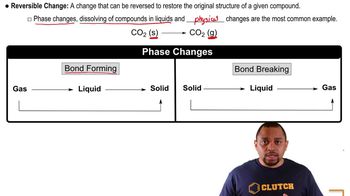
Phase changes refer to the transitions between different states of matter, such as solid, liquid, and gas. These changes can involve energy exchanges and affect the entropy of a system. For instance, when steam condenses into water, the process decreases the entropy of the water molecules as they become more ordered. Understanding phase changes is essential for analyzing how different states of matter influence entropy and energy distribution.
추천 영상:
가이드 코스
03:40
Physical & Chemical Changes