
Ch.7 Chemical Reactions: Energy, Rate and Equilibrium
McMurry - Fundamentals of General, Organic, and Biological Chemistry 8th Edition
McMurry8th EditionFundamentals of General, Organic, and Biological ChemistryISBN: 9780134015187당신이 사용하는 게 아니라요?교과서 변경
7장, 문제 69d

Magnetite, an iron ore with formula Fe3O4, can be reduced by treatment with hydrogen to yield iron metal and water vapor.
d. This reaction has K = 2.3 × 10⁻¹⁸. Are the reactants or the products favored?

검증된 단계별 안내
1
Step 1: Understand the equilibrium constant (K). The equilibrium constant (K) is a measure of the extent to which a reaction proceeds to form products at equilibrium. A very small K value (K << 1) indicates that the reactants are favored, while a very large K value (K >> 1) indicates that the products are favored.
Step 2: Analyze the given K value. In this problem, K = 2.3 × 10^(-18), which is an extremely small number. This suggests that the reaction does not proceed significantly toward the products and that the reactants are heavily favored at equilibrium.
Step 3: Relate the K value to the reaction. For the reaction Fe3O4 + H2 → Fe + H2O, the small K value implies that the concentration of the reactants (Fe3O4 and H2) will be much higher than the concentration of the products (Fe and H2O) at equilibrium.
Step 4: Conclude which side is favored. Since K is very small, the equilibrium lies far to the left, meaning the reactants are favored over the products.
Step 5: Summarize the reasoning. The extremely small equilibrium constant (K = 2.3 × 10^(-18)) indicates that the reaction does not proceed significantly toward the formation of products, and the reactants are strongly favored at equilibrium.

비슷한 문제에 대한 검증된 영상 답변:

이 영상 해법은 위 문제에 도움이 된다고 튜터들이 추천한 것입니다.
영상 길이:
1m
도움이 되었나요?

주요 개념

질문에 올바르게 답하기 위해 반드시 이해해야 하는 핵심 개념들은 다음과 같습니다.

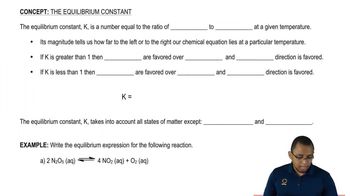
Equilibrium Constant (K)

The equilibrium constant (K) is a numerical value that expresses the ratio of the concentrations of products to reactants at equilibrium for a given reaction. A small K value, such as 2.3 x 10^-18, indicates that at equilibrium, the concentration of reactants is much greater than that of products, suggesting that the reaction favors the reactants.
추천 영상:
가이드 코스
02:50
The Equilibrium Constant Concept 1

Reaction Favorability

Reaction favorability refers to the tendency of a chemical reaction to proceed in the forward direction (toward products) or reverse direction (toward reactants). In this case, a very low equilibrium constant suggests that the formation of products (iron metal and water vapor) is highly unfavorable compared to the reactants (magnetite and hydrogen).
추천 영상:
가이드 코스
1:30
Alcohol Reactions: Dehydration Reactions Concept 1

Le Chatelier's Principle

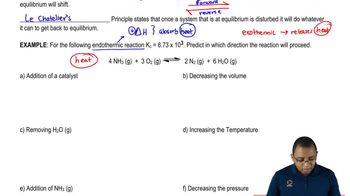
Le Chatelier's Principle states that if a system at equilibrium is subjected to a change in concentration, temperature, or pressure, the system will adjust to counteract that change and restore a new equilibrium. Understanding this principle helps predict how changes in conditions might affect the favorability of the reaction between magnetite and hydrogen.
추천 영상:
가이드 코스
09:34
The following is an endothermic reaction where Kc = 6.73 x 10³.For each of the choices below predict in which direction the reaction will proceed