Ch.7 Chemical Reactions: Energy, Rate and Equilibrium
McMurry - Fundamentals of General, Organic, and Biological Chemistry 8th Edition
McMurry8th EditionFundamentals of General, Organic, and Biological ChemistryISBN: 9780134015187당신이 사용하는 게 아니라요?교과서 변경
7장, 문제 67e

For the unbalanced combustion reaction shown, 1 mol of ethanol, C2H5OH, releases 327 kcal (1370 kJ):
C2H5OH + O2 → CO2 + H2O
e. If the density of ethanol is 0.789 g/mL, calculate the combustion energy of ethanol in kilocalories/milliliter and kilojoules/milliliter

검증된 단계별 안내
1
Step 1: Write the balanced chemical equation for the combustion of ethanol. Ethanol (C₂H₅OH) reacts with oxygen (O₂) to produce carbon dioxide (CO₂) and water (H₂O). The balanced equation is: C₂H₅OH + 3O₂ → 2CO₂ + 3H₂O.
Step 2: Calculate the molar mass of ethanol (C₂H₅OH). Add the atomic masses of its constituent atoms: (2 × C) + (6 × H) + (1 × O). Use the periodic table to find the atomic masses: C = 12.01 g/mol, H = 1.008 g/mol, O = 16.00 g/mol.
Step 3: Determine the mass of 1 mL of ethanol using its density. The density of ethanol is given as 0.789 g/mL, so the mass of 1 mL of ethanol is 0.789 g.
Step 4: Convert the mass of ethanol in 1 mL to moles. Use the formula: moles = mass / molar mass. Substitute the mass of ethanol (0.789 g) and the molar mass calculated in Step 2.
Step 5: Calculate the combustion energy of ethanol in kilocalories/milliliter and kilojoules/milliliter. Multiply the moles of ethanol (from Step 4) by the energy released per mole of ethanol (327 kcal/mol or 1370 kJ/mol). This will give the energy released per milliliter of ethanol in both units.

비슷한 문제에 대한 검증된 영상 답변:

이 영상 해법은 위 문제에 도움이 된다고 튜터들이 추천한 것입니다.
영상 길이:
7m

주요 개념

질문에 올바르게 답하기 위해 반드시 이해해야 하는 핵심 개념들은 다음과 같습니다.

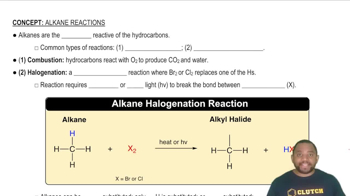
Combustion Reaction

A combustion reaction is a chemical process in which a substance (usually a hydrocarbon) reacts with oxygen to produce carbon dioxide and water, releasing energy in the form of heat. In this case, ethanol (C2H5OH) combusts with oxygen (O2) to yield carbon dioxide (CO2) and water (H2O), which is essential for understanding the energy release associated with the reaction.
추천 영상:
가이드 코스
2:25
Common Types of Alkane Reactions Concept 1

Energy Conversion

Energy conversion in this context refers to the transformation of chemical energy stored in ethanol into thermal energy during combustion. The problem states that 1 mole of ethanol releases 327 kcal (1370 kJ), which is crucial for calculating the energy per milliliter based on the density of ethanol, allowing for a comparison of energy content in different units.
추천 영상:
가이드 코스
03:45
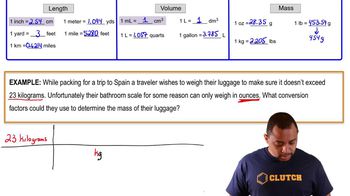
Conversion Factors (Simplified) Example 2

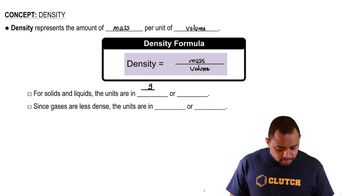
Density and Volume Calculations

Density is defined as mass per unit volume and is a key factor in converting between grams and milliliters. Given the density of ethanol (0.789 g/mL), one can determine the mass of ethanol in a specific volume, which is necessary for calculating the total energy released per milliliter during combustion, thereby linking physical properties to energy content.
추천 영상: