
Ch.7 Chemical Reactions: Energy, Rate and Equilibrium
McMurry - Fundamentals of General, Organic, and Biological Chemistry 8th Edition
McMurry8th EditionFundamentals of General, Organic, and Biological ChemistryISBN: 9780134015187당신이 사용하는 게 아니라요?교과서 변경
7장, 문제 68b

For the production of ammonia from its elements, ∆H = -22 kcal/mol(-19 kJ/mol).
b. How much energy (in kilocalories and kilojoules) is involved in the production of 0.700 mol of NH3?

검증된 단계별 안내
1
Step 1: Understand the problem. The reaction involves the production of ammonia (NH₃) from its elements, and the enthalpy change (∆H) is given as -22 kcal/mol (-19 kJ/mol). This means that for every 1 mole of NH₃ produced, 22 kcal (or 19 kJ) of energy is released.
Step 2: Identify the amount of NH₃ produced. The problem states that 0.700 mol of NH₃ is produced. We need to calculate the energy released for this specific amount in both kilocalories and kilojoules.
Step 3: Use the relationship between moles and energy. Multiply the given enthalpy change (∆H) by the number of moles of NH₃ produced. For kilocalories, the formula is: E=∆H×n, where n is the number of moles. Similarly, use the same formula for kilojoules.
Step 4: Substitute the values into the formulas. For kilocalories: E=-22×0.700. For kilojoules: E=-19×0.700.
Step 5: Perform the calculations to find the energy released in both kilocalories and kilojoules. Remember to include the negative sign in your final answers, as it indicates that energy is released (exothermic process).

비슷한 문제에 대한 검증된 영상 답변:

이 영상 해법은 위 문제에 도움이 된다고 튜터들이 추천한 것입니다.
영상 길이:
3m

주요 개념

질문에 올바르게 답하기 위해 반드시 이해해야 하는 핵심 개념들은 다음과 같습니다.

Enthalpy Change (∆H)

Enthalpy change (∆H) represents the heat content change during a chemical reaction at constant pressure. In this case, a negative ∆H indicates that the reaction is exothermic, meaning it releases energy. Understanding this concept is crucial for calculating the total energy involved in the production of ammonia from its elements.
추천 영상:
가이드 코스
01:17
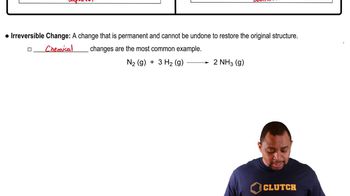
Physical & Chemical Changes

Stoichiometry

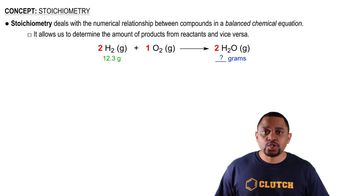
Stoichiometry is the branch of chemistry that deals with the quantitative relationships between reactants and products in a chemical reaction. It allows us to determine how much of each substance is involved based on the balanced chemical equation. For the ammonia production reaction, stoichiometry helps in calculating the energy change for a specific amount of ammonia produced.
추천 영상:

Unit Conversion

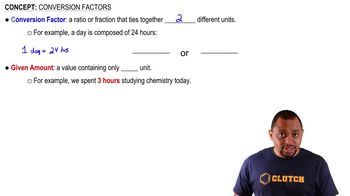
Unit conversion is the process of converting a quantity expressed in one set of units to another. In this question, it is necessary to convert energy values between kilocalories and kilojoules. Understanding how to perform these conversions is essential for accurately reporting the energy involved in the production of ammonia in both units.
추천 영상:
가이드 코스
01:56
Conversion Factors (Simplified) Concept 1