Ch.9 Solutions
McMurry - Fundamentals of General, Organic, and Biological Chemistry 8th Edition
McMurry8th EditionFundamentals of General, Organic, and Biological ChemistryISBN: 9780134015187당신이 사용하는 게 아니라요?교과서 변경
9장, 문제 81b

Which of the following solutions has the higher osmolarity?
b. 0.30 M NaOH or 3.0% (m/v) NaOH

검증된 단계별 안내
1
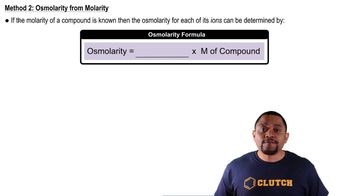
Step 1: Understand the concept of osmolarity. Osmolarity is the total concentration of all solute particles in a solution. For ionic compounds like NaOH, it dissociates into ions in water. Each mole of NaOH dissociates into one mole of Na⁺ and one mole of OH⁻, contributing two particles to the osmolarity.
Step 2: Calculate the osmolarity of the 0.30 M NaOH solution. Since NaOH dissociates completely into two particles (Na⁺ and OH⁻), the osmolarity is given by: \( \text{Osmolarity} = \text{Molarity} \times \text{Number of particles per formula unit} \). Substitute \( \text{Molarity} = 0.30 \) M and \( \text{Number of particles} = 2 \).
Step 3: Convert the 3.0% (m/v) NaOH solution into molarity. The % (m/v) means 3.0 g of NaOH is dissolved in 100 mL of solution. First, calculate the number of moles of NaOH using its molar mass (NaOH has a molar mass of approximately 40.00 g/mol): \( \text{Moles of NaOH} = \frac{\text{Mass of NaOH}}{\text{Molar mass of NaOH}} \). Then, convert the volume from mL to L and calculate molarity: \( \text{Molarity} = \frac{\text{Moles of NaOH}}{\text{Volume in liters}} \).
Step 4: Calculate the osmolarity of the 3.0% (m/v) NaOH solution. Use the same formula as in Step 2: \( \text{Osmolarity} = \text{Molarity} \times \text{Number of particles per formula unit} \). Substitute the molarity calculated in Step 3 and \( \text{Number of particles} = 2 \).
Step 5: Compare the osmolarities of the two solutions. The solution with the higher osmolarity will have the greater total concentration of solute particles. Use the results from Steps 2 and 4 to determine which solution has the higher osmolarity.

비슷한 문제에 대한 검증된 영상 답변:

이 영상 해법은 위 문제에 도움이 된다고 튜터들이 추천한 것입니다.
영상 길이:
8m
도움이 되었나요?

주요 개념

질문에 올바르게 답하기 위해 반드시 이해해야 하는 핵심 개념들은 다음과 같습니다.

Osmolarity

Osmolarity is a measure of the total concentration of solute particles in a solution. It is expressed in osmoles per liter (osmol/L) and takes into account all particles that contribute to the solution's osmotic pressure, including ions and molecules. For ionic compounds like NaOH, which dissociates into sodium (Na+) and hydroxide (OH-) ions, the osmolarity is calculated by multiplying the molarity by the number of particles produced upon dissociation.
추천 영상:

Molarity

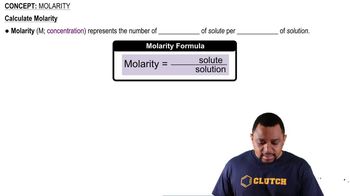
Molarity is a way to express the concentration of a solution, defined as the number of moles of solute per liter of solution (mol/L). In the case of NaOH, a 0.30 M solution means there are 0.30 moles of NaOH in one liter of solution. Understanding molarity is essential for calculating osmolarity, especially for ionic compounds that dissociate in solution.
추천 영상:

Mass/Volume Percent Concentration

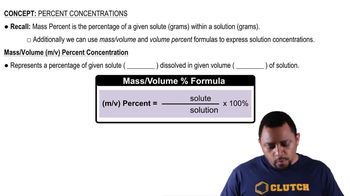
Mass/volume percent concentration (m/v) is a way to express the concentration of a solution as the mass of solute per 100 mL of solution. For example, a 3.0% (m/v) NaOH solution means there are 3 grams of NaOH in 100 mL of solution. This concept is important for converting to molarity and subsequently calculating osmolarity, especially when comparing different types of concentration measurements.
추천 영상:
가이드 코스
00:52
Percent Concentrations Concept 1