
Ch.9 Solutions
McMurry - Fundamentals of General, Organic, and Biological Chemistry 8th Edition
McMurry8th EditionFundamentals of General, Organic, and Biological ChemistryISBN: 9780134015187당신이 사용하는 게 아니라요?교과서 변경
9장, 문제 84

An isotonic solution must be approximately 0.30 osmol/L. How much KCl is needed to prepare 175 mL of an isotonic solution?

검증된 단계별 안내
1
Step 1: Understand the concept of isotonic solutions. An isotonic solution has the same osmolarity as body fluids, which is approximately 0.30 osmol/L. Osmolarity is the total concentration of solute particles in a solution.
Step 2: Recognize that potassium chloride (KCl) dissociates completely in water into two ions: K⁺ and Cl⁻. Therefore, 1 mole of KCl produces 2 osmoles of particles. This means the osmolarity of the solution is twice the molarity of KCl.
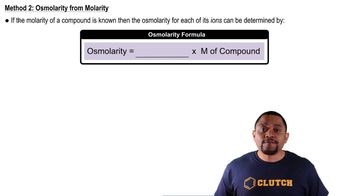
Step 3: Use the formula for osmolarity: \( \text{Osmolarity} = \text{Molarity} \times \text{Number of particles per formula unit} \). Rearrange the formula to solve for molarity: \( \text{Molarity} = \frac{\text{Osmolarity}}{\text{Number of particles per formula unit}} \). Substitute \( \text{Osmolarity} = 0.30 \; \text{osmol/L} \) and \( \text{Number of particles per formula unit} = 2 \).
Step 4: Calculate the number of moles of KCl needed using the molarity formula: \( \text{Molarity} = \frac{\text{moles of solute}}{\text{volume of solution in liters}} \). Rearrange to solve for moles: \( \text{moles of solute} = \text{Molarity} \times \text{volume of solution in liters} \). Convert 175 mL to liters by dividing by 1000.
Step 5: Convert the moles of KCl to grams using the molar mass of KCl. The molar mass of KCl is approximately 74.55 g/mol. Use the formula: \( \text{mass of KCl} = \text{moles of KCl} \times \text{molar mass of KCl} \).

비슷한 문제에 대한 검증된 영상 답변:

이 영상 해법은 위 문제에 도움이 된다고 튜터들이 추천한 것입니다.
영상 길이:
5m
도움이 되었나요?

주요 개념

질문에 올바르게 답하기 위해 반드시 이해해야 하는 핵심 개념들은 다음과 같습니다.

Osmolarity

Osmolarity is a measure of the total concentration of solute particles in a solution. It is expressed in osmoles per liter (osmol/L) and is crucial for understanding how solutions affect cell volume and function. An isotonic solution has the same osmolarity as body fluids, preventing net movement of water across cell membranes.
추천 영상:

Isotonic Solutions

An isotonic solution is one that has the same osmotic pressure as another solution, typically bodily fluids. This means that when cells are placed in an isotonic solution, there is no net movement of water into or out of the cells, maintaining their shape and function. For human cells, an isotonic solution is approximately 0.30 osmol/L.
추천 영상:

KCl Preparation

Potassium chloride (KCl) is often used to create isotonic solutions in laboratory settings. To prepare a specific osmolarity, one must calculate the amount of KCl needed based on its dissociation in solution. KCl dissociates into potassium (K+) and chloride (Cl-) ions, contributing to the total osmolarity, which must be considered when preparing the solution.
추천 영상:
가이드 코스
01:13
Entropy (Simplified) Example 2