
Emergency treatment of cardiac arrest victims sometimes involves injection of a calcium chloride solution directly into the heart muscle. How many grams of CaCl2 are administered in an injection of 5.0 mL of a 5.0% (m/v) solution? How many milliequivalents of Ca2+?
Ch.9 Solutions
McMurry8th EditionFundamentals of General, Organic, and Biological ChemistryISBN: 9780134015187당신이 사용하는 게 아니라요?교과서 변경
9장, 문제 82
Which of the following solutions will give rise to a greater osmotic pressure at equilibrium: 5.00 g of NaCl in 350.0 mL water or 35.0 g of glucose in 400.0 mL water? For NaCl, MW = 58.5 amu; for glucose, MW = 180 amu.
검증된 단계별 안내1
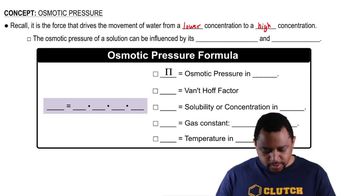
Step 1: Recall the formula for osmotic pressure: Π = iMRT, where Π is the osmotic pressure, i is the van 't Hoff factor (number of particles the solute dissociates into), M is the molarity of the solution, R is the gas constant, and T is the temperature in Kelvin. Since R and T are constant for both solutions, compare the product of i and M for each solution to determine which has the greater osmotic pressure.
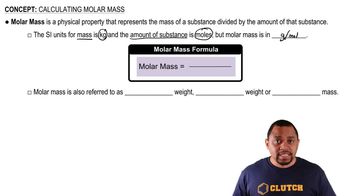
Step 2: Calculate the number of moles of NaCl. Use the formula: moles = mass / molar mass. For NaCl, the mass is 5.00 g and the molar mass is 58.5 g/mol. Substitute these values into the formula to find the moles of NaCl.
Step 3: Determine the molarity of the NaCl solution. Molarity (M) is calculated as moles of solute divided by the volume of solution in liters. Convert 350.0 mL to liters (350.0 mL = 0.350 L), then divide the moles of NaCl by 0.350 L to find the molarity. Remember that NaCl dissociates into two particles (Na⁺ and Cl⁻), so the van 't Hoff factor (i) for NaCl is 2.
Step 4: Calculate the number of moles of glucose. Use the formula: moles = mass / molar mass. For glucose, the mass is 35.0 g and the molar mass is 180 g/mol. Substitute these values into the formula to find the moles of glucose.
Step 5: Determine the molarity of the glucose solution. Convert 400.0 mL to liters (400.0 mL = 0.400 L), then divide the moles of glucose by 0.400 L to find the molarity. Since glucose does not dissociate in solution, its van 't Hoff factor (i) is 1. Compare the product of i and M for both solutions to determine which has the greater osmotic pressure.

비슷한 문제에 대한 검증된 영상 답변:
이 영상 해법은 위 문제에 도움이 된다고 튜터들이 추천한 것입니다.
영상 길이:
14m도움이 되었나요?
주요 개념
질문에 올바르게 답하기 위해 반드시 이해해야 하는 핵심 개념들은 다음과 같습니다.
Osmotic Pressure
Osmotic pressure is the pressure required to prevent the flow of solvent into a solution through a semipermeable membrane. It is directly proportional to the concentration of solute particles in the solution. The formula for osmotic pressure (π) is π = iCRT, where 'i' is the van 't Hoff factor (number of particles the solute dissociates into), 'C' is the molarity of the solution, 'R' is the ideal gas constant, and 'T' is the temperature in Kelvin.
추천 영상:
가이드 코스
Osmotic Pressure Concept 1
Van 't Hoff Factor (i)
The van 't Hoff factor (i) indicates the number of particles a solute dissociates into in solution. For example, NaCl dissociates into two ions (Na+ and Cl-), giving it an i value of 2, while glucose does not dissociate and has an i value of 1. This factor is crucial for calculating osmotic pressure, as it affects the total concentration of solute particles in the solution.
추천 영상:
가이드 코스
Conversion Factors (Simplified) Concept 1
Molarity and Mass Calculations
Molarity (M) is a measure of concentration defined as the number of moles of solute per liter of solution. To compare osmotic pressures, one must first convert the mass of solute (in grams) to moles using the formula: moles = mass (g) / molar mass (g/mol). This allows for the calculation of molarity, which is essential for determining the osmotic pressure of each solution.
추천 영상:
가이드 코스
Calculating Molar Mass
관련 실천
교과서 질문
1150
views
교과서 질문
Uric acid, the principal constituent of some kidney stones, has the formula C5H4N4O3. In aqueous solution, the solubility of uric acid is only 0.067 g/L. Express this concentration in (m/v)%, in parts per million, and in molarity.
1391
views
교과서 질문
Which of the following solutions has the higher osmolarity?
b. 0.30 M NaOH or 3.0% (m/v) NaOH
1802
views
교과서 질문
The concentration of Cl- ion in blood is approximately 100 mEq/L. How many milliliters of blood would be needed to obtain 1.0 g of Cl- ions?
1603
views
교과서 질문
What does it mean when we say that a 0.15 M NaCl solution is isotonic with blood, whereas distilled water is hypotonic?
2882
views
교과서 질문
An isotonic solution must be approximately 0.30 osmol/L. How much KCl is needed to prepare 175 mL of an isotonic solution?
2379
views
