Ch.13 Alkenes, Alkynes, and Aromatic Compounds
McMurry - Fundamentals of General, Organic, and Biological Chemistry 8th Edition
McMurry8th EditionFundamentals of General, Organic, and Biological ChemistryISBN: 9780134015187당신이 사용하는 게 아니라요?교과서 변경
13장, 문제 7

Classify the following reactions as an addition, elimination, or substitution:
a. CH3Br + NaOH → CH3OH + NaBr
b. H2C═CH2 + HCl → CH3CH2Cl
c. CH3CH2Br → H2C═CH2 + HBr

검증된 단계별 안내
1
Step 1: Understand the three types of reactions: Addition reactions involve adding atoms or groups to a molecule, typically across a double or triple bond. Elimination reactions involve the removal of atoms or groups from a molecule, often resulting in the formation of a double or triple bond. Substitution reactions involve replacing one atom or group in a molecule with another.
Step 2: Analyze reaction (a): CH₃Br + NaOH → CH₃OH + NaBr. In this reaction, the bromine atom (Br) in CH₃Br is replaced by a hydroxyl group (OH) from NaOH, forming CH₃OH and NaBr. This is a substitution reaction.
Step 3: Analyze reaction (b): H₂C═CH₂ + HCl → CH₃CH₂Cl. Here, the double bond in ethene (H₂C═CH₂) is broken, and a hydrogen atom (H) and a chlorine atom (Cl) are added to the molecule, forming CH₃CH₂Cl. This is an addition reaction.
Step 4: Analyze reaction (c): CH₃CH₂Br → H₂C═CH₂ + HBr. In this reaction, a hydrogen atom (H) and a bromine atom (Br) are removed from CH₃CH₂Br, resulting in the formation of a double bond in H₂C═CH₂. This is an elimination reaction.
Step 5: Summarize the classifications: (a) is a substitution reaction, (b) is an addition reaction, and (c) is an elimination reaction. These classifications are based on the changes occurring in the reactants and products.

비슷한 문제에 대한 검증된 영상 답변:

이 영상 해법은 위 문제에 도움이 된다고 튜터들이 추천한 것입니다.
도움이 되었나요?

주요 개념

질문에 올바르게 답하기 위해 반드시 이해해야 하는 핵심 개념들은 다음과 같습니다.

Addition Reactions

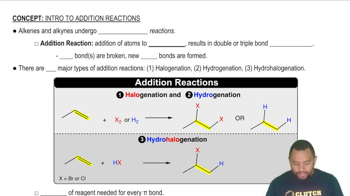
Addition reactions involve the combination of two or more reactants to form a single product. In these reactions, unsaturated compounds, such as alkenes or alkynes, react with other molecules, resulting in the formation of new bonds. A common example is the reaction of ethylene (H₂C═CH₂) with hydrogen chloride (HCl) to produce chloroethane (CH₃CH₂Cl).
추천 영상:
가이드 코스
2:55
Addition Reactions Concept 1

Elimination Reactions

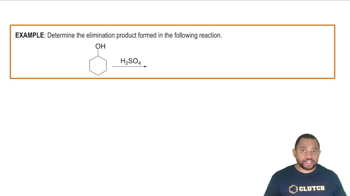
Elimination reactions occur when a single reactant breaks down into two products, typically involving the removal of a small molecule like water or hydrogen halide. These reactions often convert saturated compounds into unsaturated ones. For instance, the reaction of bromoethane (CH₃CH₂Br) to form ethylene (H₂C═CH₂) and hydrogen bromide (HBr) is a classic example of an elimination reaction.
추천 영상:
가이드 코스
1:13
Alcohol Reactions Dehydration Reactions Example 1

Substitution Reactions

Substitution reactions involve the replacement of one atom or group in a molecule with another atom or group. This type of reaction is common in organic chemistry, particularly with alkyl halides. An example is the reaction of methyl bromide (CH₃Br) with sodium hydroxide (NaOH), where the bromine atom is replaced by a hydroxyl group, resulting in methanol (CH₃OH) and sodium bromide (NaBr).
추천 영상:
가이드 코스
5:07
Naming Alkanes with Substituents Example 1