Ch.13 Alkenes, Alkynes, and Aromatic Compounds
McMurry - Fundamentals of General, Organic, and Biological Chemistry 8th Edition
McMurry8th EditionFundamentals of General, Organic, and Biological ChemistryISBN: 9780134015187당신이 사용하는 게 아니라요?교과서 변경
13장, 문제 2

Draw both condensed and line structures corresponding to the following IUPAC names:
a. 3-Methyl-1-heptene
b. 4,4-Dimethyl-2-pentyne
c. 2-Methyl-3-hexene
d. 1,3,3-Trimethylcyclohexene

검증된 단계별 안내
1
Step 1: Understand the IUPAC naming conventions. For each compound, identify the main chain, the position of double or triple bonds, and the substituents. This will guide the drawing of both condensed and line structures.
Step 2: For 3-Methyl-1-heptene: Start with a 7-carbon chain (heptene) with a double bond at position 1. Add a methyl group (CH₃) at position 3. Draw the condensed structure by writing out each group explicitly (e.g., CH₃-CH=CH-...). For the line structure, represent the main chain as a zigzag line with the double bond and methyl group clearly indicated.
Step 3: For 4,4-Dimethyl-2-pentyne: Begin with a 5-carbon chain (pentyne) with a triple bond at position 2. Add two methyl groups (CH₃) at position 4. Draw the condensed structure by explicitly showing each group (e.g., CH₃-C≡C-...). For the line structure, use a zigzag line with the triple bond and methyl groups clearly marked.
Step 4: For 2-Methyl-3-hexene: Start with a 6-carbon chain (hexene) with a double bond at position 3. Add a methyl group (CH₃) at position 2. Draw the condensed structure by writing out each group explicitly (e.g., CH₃-CH(CH₃)-CH=...). For the line structure, represent the main chain as a zigzag line with the double bond and methyl group clearly indicated.
Step 5: For 1,3,3-Trimethylcyclohexene: Begin with a cyclohexene ring (6-membered ring with a double bond). Add three methyl groups (CH₃): one at position 1 and two at position 3. Draw the condensed structure by explicitly showing the ring and substituents (e.g., CH₂=C(CH₃)-...). For the line structure, represent the ring as a hexagon with the double bond and methyl groups clearly marked.

비슷한 문제에 대한 검증된 영상 답변:

이 영상 해법은 위 문제에 도움이 된다고 튜터들이 추천한 것입니다.
도움이 되었나요?

주요 개념

질문에 올바르게 답하기 위해 반드시 이해해야 하는 핵심 개념들은 다음과 같습니다.

IUPAC Nomenclature

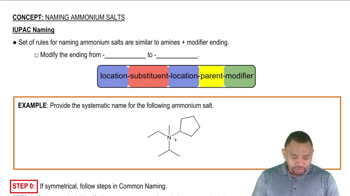
IUPAC nomenclature is a systematic method for naming chemical compounds. It provides a set of rules to derive names based on the structure of the molecule, including the longest carbon chain, functional groups, and substituents. Understanding these rules is essential for accurately interpreting and drawing the structures of organic compounds.
추천 영상:
가이드 코스
3:18
IUPAC Naming Concept 3

Condensed Structures

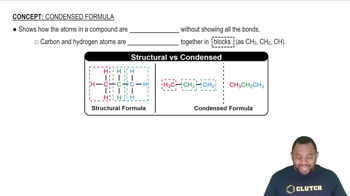
Condensed structures are a simplified way of representing molecular structures where atoms are grouped together to show connectivity without depicting all bonds explicitly. In these structures, carbon atoms and their attached hydrogens are often written in a linear format, making it easier to visualize the molecular framework without drawing every bond.
추천 영상:
가이드 코스
1:53
Condensed Formula Concept 1

Line Structures

Line structures, also known as skeletal structures, are a representation of organic molecules where carbon atoms are represented by vertices and lines indicate bonds. This format omits hydrogen atoms attached to carbons, simplifying the drawing and focusing on the connectivity and arrangement of the carbon skeleton and functional groups, which is crucial for understanding the compound's reactivity and properties.
추천 영상:
가이드 코스
01:59
Resonance Structures (Simplified) Concept 1