
Ch.17 Carboxylic Acids and Their Derivatives
McMurry - Fundamentals of General, Organic, and Biological Chemistry 8th Edition
McMurry8th EditionFundamentals of General, Organic, and Biological ChemistryISBN: 9780134015187당신이 사용하는 게 아니라요?교과서 변경
17장, 문제 20a

Draw structures of the amides that can be made from the following reactants:
a. CH3NH2 + (CH3)2CHCOOH →?

검증된 단계별 안내
1
Identify the functional groups in the reactants: CH₃NH₂ is a primary amine, and (CH₃)₂CHCOOH is a carboxylic acid. Amides are formed when an amine reacts with a carboxylic acid, typically through a condensation reaction where water (H₂O) is eliminated.
Determine the mechanism of the reaction: The amine (CH₃NH₂) will act as a nucleophile, attacking the carbonyl carbon of the carboxylic acid ((CH₃)₂CHCOOH). This forms a tetrahedral intermediate.
Recognize the elimination step: The tetrahedral intermediate will lose a molecule of water (H₂O), resulting in the formation of the amide bond (C=O-NH).
Draw the structure of the resulting amide: The amide will have the structure (CH₃)₂CH-C(=O)-NH-CH₃. The isopropyl group ((CH₃)₂CH-) comes from the carboxylic acid, and the methyl group (CH₃-) attached to the nitrogen comes from the amine.
Verify the product: Ensure that the product contains the amide functional group (-C(=O)-NH-) and that all atoms are accounted for from the reactants, with water (H₂O) as the byproduct.

비슷한 문제에 대한 검증된 영상 답변:

이 영상 해법은 위 문제에 도움이 된다고 튜터들이 추천한 것입니다.
영상 길이:
2m
도움이 되었나요?

주요 개념

질문에 올바르게 답하기 위해 반드시 이해해야 하는 핵심 개념들은 다음과 같습니다.

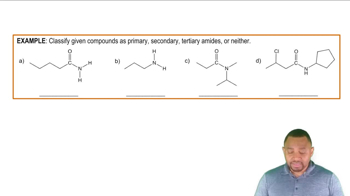
Amides

Amides are organic compounds derived from carboxylic acids where the hydroxyl group (-OH) is replaced by an amine group (-NH₂, -NHR, or -NR₂). They are characterized by the functional group -C(=O)N-, and are important in various biological processes, including protein synthesis. Understanding the structure of amides is crucial for predicting their reactivity and properties.
추천 영상:
가이드 코스
1:03
Intro to Amides Example 1

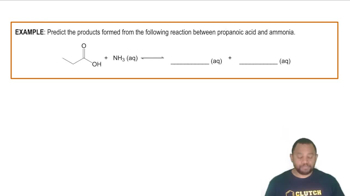
Carboxylic Acids

Carboxylic acids are organic compounds containing a carboxyl group (-COOH), which is responsible for their acidic properties. They can react with amines to form amides through a condensation reaction, where water is eliminated. Recognizing the structure and reactivity of carboxylic acids is essential for understanding how amides are synthesized.
추천 영상:
가이드 코스
1:09
Carboxylic Acid Reactions Example 1

Condensation Reaction

A condensation reaction is a chemical process where two molecules combine to form a larger molecule, accompanied by the loss of a small molecule, often water. In the context of amide formation, the reaction between an amine and a carboxylic acid exemplifies this process. Grasping the concept of condensation reactions is vital for predicting the products formed in organic synthesis.
추천 영상:
가이드 코스
1:53
Condensed Formula Concept 1