

Ch.17 Carboxylic Acids and Their Derivatives
McMurry - Fundamentals of General, Organic, and Biological Chemistry 8th Edition
McMurry8th EditionFundamentals of General, Organic, and Biological ChemistryISBN: 9780134015187당신이 사용하는 게 아니라요?교과서 변경
17장, 문제 20b

Draw structures of the amides that can be made from the following reactants:
b. Chemical reaction diagram showing an amine and a carboxylic acid reacting to form an amide, with a question mark indicating the product.

검증된 단계별 안내
1
Identify the reactants involved in the formation of the amide. Amides are typically formed through a reaction between a carboxylic acid (or its derivative) and an amine. Examine the provided image to determine the functional groups present in the reactants.
Determine the functional group transformation. In the formation of an amide, the hydroxyl group (-OH) of the carboxylic acid is replaced by the amine group (-NH2 or a substituted amine). This process often involves a condensation reaction, where water (H2O) is eliminated.
Draw the structure of the carboxylic acid reactant. Ensure that the carbonyl group (C=O) and hydroxyl group (-OH) are correctly represented.
Draw the structure of the amine reactant. If the amine is primary (R-NH2), secondary (R2-NH), or tertiary (R3-N), ensure the correct number of substituents (R groups) are attached to the nitrogen atom.
Combine the two structures to form the amide. Replace the hydroxyl group (-OH) of the carboxylic acid with the amine group, forming a bond between the carbonyl carbon and the nitrogen atom. Ensure the resulting structure reflects the correct connectivity and bonding.

비슷한 문제에 대한 검증된 영상 답변:

이 영상 해법은 위 문제에 도움이 된다고 튜터들이 추천한 것입니다.
영상 길이:
3m
도움이 되었나요?

주요 개념

질문에 올바르게 답하기 위해 반드시 이해해야 하는 핵심 개념들은 다음과 같습니다.

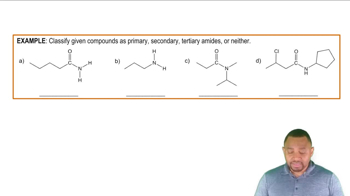
Amides

Amides are organic compounds derived from carboxylic acids where the hydroxyl group (-OH) is replaced by an amine group (-NH2, -NHR, or -NR2). They are characterized by the functional group -C(=O)N-, which plays a crucial role in their chemical properties and reactivity. Amides can be formed through the reaction of carboxylic acids with amines, making them important in both synthetic and biological chemistry.
추천 영상:
가이드 코스
1:03
Intro to Amides Example 1

Reactants in Organic Chemistry

In organic chemistry, reactants are the starting materials that undergo a chemical reaction to form products. Understanding the nature of the reactants, such as their functional groups and structural features, is essential for predicting the outcome of a reaction. In the context of amide formation, identifying the specific carboxylic acid and amine reactants is key to determining the structure of the resulting amide.
추천 영상:
가이드 코스
2:26
Introduction to Organic Chemistry Concept 1

Chemical Structure Drawing

Drawing chemical structures involves representing the arrangement of atoms and the bonds between them in a molecule. This skill is vital for visualizing and understanding the properties of compounds, including amides. Accurate structural representation helps in predicting reactivity, stability, and interactions with other molecules, which is essential for answering questions related to organic synthesis.
추천 영상:
가이드 코스
00:58
Chemical Reaction: Chemical Change Concept 1