Ch.17 Carboxylic Acids and Their Derivatives
McMurry - Fundamentals of General, Organic, and Biological Chemistry 8th Edition
McMurry8th EditionFundamentals of General, Organic, and Biological ChemistryISBN: 9780134015187당신이 사용하는 게 아니라요?교과서 변경
17장, 문제 71b

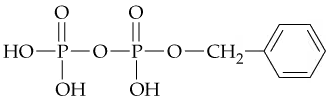
In the following compound

b. Identify the phosphate anhydride linkage.

검증된 단계별 안내
1
Understand the term 'phosphate anhydride linkage': A phosphate anhydride linkage is a bond formed between two phosphate groups through the loss of a water molecule. This type of bond is commonly found in molecules like ATP (adenosine triphosphate).
Examine the structure of the compound provided in the image: Look for regions where two phosphate groups are directly connected by an oxygen atom, indicating the presence of a phosphate anhydride bond.
Identify the specific bond: Locate the bond between the phosphorus atoms of the two phosphate groups. This bond is typically represented as P-O-P, where the oxygen atom bridges the two phosphorus atoms.
Verify the linkage: Ensure that the bond you identified is indeed an anhydride bond by confirming that it connects two phosphate groups and is formed by the removal of a water molecule.
Label the phosphate anhydride linkage: Clearly mark or highlight the identified bond in the compound structure to indicate the phosphate anhydride linkage.

비슷한 문제에 대한 검증된 영상 답변:

이 영상 해법은 위 문제에 도움이 된다고 튜터들이 추천한 것입니다.
도움이 되었나요?

주요 개념

질문에 올바르게 답하기 위해 반드시 이해해야 하는 핵심 개념들은 다음과 같습니다.

Phosphate Anhydride Linkage

A phosphate anhydride linkage is a type of chemical bond formed between two phosphate groups through the removal of a water molecule. This bond is crucial in biochemistry, particularly in the formation of ATP (adenosine triphosphate), where energy is stored and released during cellular processes. Understanding this linkage is essential for grasping how energy transfer occurs in biological systems.
추천 영상:
가이드 코스
1:44
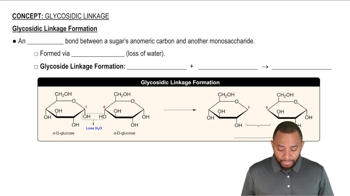
Glycosidic Linkage Formation Concept 1

Chemical Structure of Nucleotides

Nucleotides are the building blocks of nucleic acids like DNA and RNA, consisting of a phosphate group, a sugar, and a nitrogenous base. The arrangement of these components, particularly the phosphate groups, is vital for understanding how nucleotides link together to form long chains. Recognizing the structure helps in identifying functional groups and their roles in biochemical reactions.
추천 영상:
가이드 코스
1:19
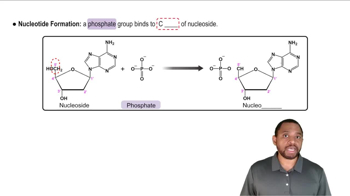
Nucleoside and Nucleotide Formation Concept 2

Role of Phosphate in Energy Transfer

Phosphate groups play a critical role in energy transfer within cells, primarily through molecules like ATP. The high-energy bonds between phosphate groups can be broken to release energy, which is then used for various cellular activities. This concept is fundamental in biochemistry, as it explains how cells harness and utilize energy for growth, repair, and maintenance.
추천 영상:
가이드 코스
01:26
Nature of Energy