Ch.17 Carboxylic Acids and Their Derivatives
McMurry - Fundamentals of General, Organic, and Biological Chemistry 8th Edition
McMurry8th EditionFundamentals of General, Organic, and Biological ChemistryISBN: 9780134015187당신이 사용하는 게 아니라요?교과서 변경
17장, 문제 74

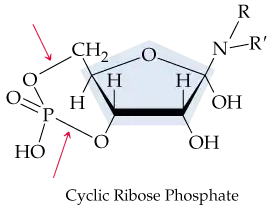
Cyclic ribose nucleotide phosphates, such as cyclic AMP (cAMP), are important signaling agents in living cells; all have the general structure shown here. What kind of linkage holds the phosphate to the ribose (see arrows; ribose is highlighted in blue)?
Cyclic ribose phosphate structure with arrows indicating phosphate linkage to ribose, highlighted in blue.

검증된 단계별 안내
1
Identify the structure of the ribose sugar: Ribose is a five-carbon sugar with hydroxyl (-OH) groups attached to its carbon atoms. In this case, the ribose is cyclic, forming a furanose ring structure.
Examine the phosphate group: The phosphate group is attached to the ribose sugar through specific bonds. Look at the arrows in the image to determine which carbons of the ribose are involved in the linkage.
Determine the type of bond: The phosphate group forms ester linkages with the hydroxyl groups on the ribose. Specifically, these are phosphoester bonds, which occur when a phosphate group reacts with an -OH group, releasing water.
Analyze the cyclic nature: In cyclic AMP (cAMP), the phosphate group forms two ester linkages with two different hydroxyl groups on the ribose, creating a cyclic structure. This is known as a cyclic phosphodiester bond.
Conclude the linkage type: The linkage holding the phosphate to the ribose in cyclic AMP is a cyclic phosphodiester bond, as the phosphate is connected to two hydroxyl groups on the ribose, forming a ring structure.

비슷한 문제에 대한 검증된 영상 답변:

이 영상 해법은 위 문제에 도움이 된다고 튜터들이 추천한 것입니다.
도움이 되었나요?

주요 개념

질문에 올바르게 답하기 위해 반드시 이해해야 하는 핵심 개념들은 다음과 같습니다.

Cyclic Nucleotide Structure

Cyclic nucleotides, like cyclic AMP (cAMP), are formed by the cyclization of ribonucleotides. This structure includes a ribose sugar, a phosphate group, and a nitrogenous base. The cyclic nature arises from a covalent bond that connects the phosphate group to the ribose, creating a ring structure that is crucial for their function as signaling molecules.
추천 영상:
가이드 코스
1:19
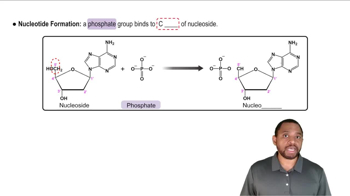
Nucleoside and Nucleotide Formation Concept 2

Phosphate-Ribose Linkage

The linkage between the phosphate group and the ribose in cyclic nucleotides is a phosphoester bond. This bond forms when the hydroxyl group of the ribose sugar reacts with the phosphate group, resulting in the release of a water molecule. This covalent bond is essential for the stability and functionality of cyclic nucleotides in cellular signaling.
추천 영상:
가이드 코스
1:44
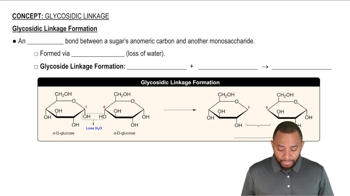
Glycosidic Linkage Formation Concept 1

Signaling Role of cAMP

Cyclic AMP (cAMP) serves as a secondary messenger in various signaling pathways within cells. It is produced from ATP by the enzyme adenylate cyclase and activates protein kinase A (PKA), which then phosphorylates target proteins to elicit cellular responses. Understanding the role of cAMP is vital for grasping how cells communicate and respond to external stimuli.
추천 영상:
가이드 코스
03:25
The Genetic Code Concept 1