
Ch.17 Carboxylic Acids and Their Derivatives
McMurry - Fundamentals of General, Organic, and Biological Chemistry 8th Edition
McMurry8th EditionFundamentals of General, Organic, and Biological ChemistryISBN: 9780134015187당신이 사용하는 게 아니라요?교과서 변경
17장, 문제 78

Propanamide and methyl acetate have about the same molar mass, both are quite soluble in water, and yet the boiling point of propanamide is 213 °C, whereas that of methyl acetate is 57 °C. Explain.

검증된 단계별 안내
1
Identify the functional groups in each compound: Propanamide contains an amide group (-CONH2), while methyl acetate contains an ester group (-COOCH3). These functional groups play a key role in determining the intermolecular forces present in each compound.
Analyze the intermolecular forces in propanamide: The amide group in propanamide can form strong hydrogen bonds due to the presence of both a hydrogen atom bonded to nitrogen (N-H) and a carbonyl group (C=O). These hydrogen bonds significantly increase the boiling point of propanamide.
Analyze the intermolecular forces in methyl acetate: The ester group in methyl acetate cannot form hydrogen bonds because it lacks a hydrogen atom bonded to a highly electronegative atom like oxygen or nitrogen. Instead, methyl acetate primarily exhibits dipole-dipole interactions and London dispersion forces, which are weaker than hydrogen bonding.
Relate the strength of intermolecular forces to boiling points: Stronger intermolecular forces, such as hydrogen bonding in propanamide, require more energy to overcome during the phase transition from liquid to gas. This results in a much higher boiling point for propanamide compared to methyl acetate, which only has weaker dipole-dipole and dispersion forces.
Conclude the explanation: The significant difference in boiling points (213 °C for propanamide vs. 57 °C for methyl acetate) is due to the presence of strong hydrogen bonding in propanamide, which is absent in methyl acetate. This highlights the impact of intermolecular forces on physical properties like boiling points.

비슷한 문제에 대한 검증된 영상 답변:

이 영상 해법은 위 문제에 도움이 된다고 튜터들이 추천한 것입니다.
도움이 되었나요?

주요 개념

질문에 올바르게 답하기 위해 반드시 이해해야 하는 핵심 개념들은 다음과 같습니다.

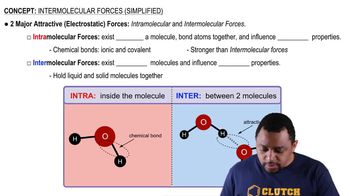
Intermolecular Forces

Intermolecular forces are the attractive forces between molecules that influence physical properties such as boiling points. Propanamide exhibits strong hydrogen bonding due to the presence of an amide group, which significantly raises its boiling point. In contrast, methyl acetate primarily experiences weaker dipole-dipole interactions and London dispersion forces, resulting in a lower boiling point.
추천 영상:
가이드 코스
01:59
Intermolecular Forces (Simplified) Concept 1

Hydrogen Bonding

Hydrogen bonding is a specific type of strong dipole-dipole interaction that occurs when hydrogen is bonded to highly electronegative atoms like nitrogen, oxygen, or fluorine. In propanamide, the nitrogen atom can form hydrogen bonds with water and other propanamide molecules, leading to a higher boiling point. Methyl acetate lacks such strong hydrogen bonding capabilities, contributing to its lower boiling point.
추천 영상:
가이드 코스
1:22
Hydrogenation Reactions Concept 1

Molar Mass vs. Boiling Point

While molar mass can influence boiling points, it is not the sole determinant. Both propanamide and methyl acetate have similar molar masses, but the type and strength of intermolecular forces play a more critical role. The significant difference in boiling points between these two compounds highlights that stronger intermolecular forces can lead to higher boiling points, regardless of similar molar masses.
추천 영상:
가이드 코스
03:05
Boiling Point Elevation Concept 1