Compare the structures of vitamin A and vitamin C. Which one is water-soluble and which is fat-soluble? What structural features does each have that make one water-soluble and the other fat-soluble?
Ch.19 Enzymes and Vitamins
McMurry8th EditionFundamentals of General, Organic, and Biological ChemistryISBN: 9780134015187당신이 사용하는 게 아니라요?교과서 변경
19장, 문제 25a
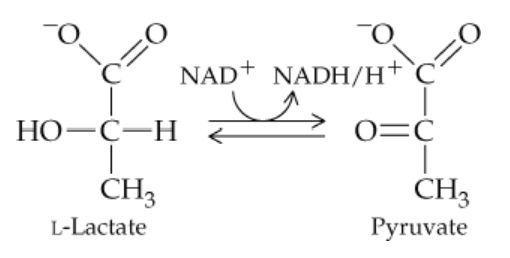
Answer questions (a)–(e) concerning the following reaction:

a. The enzyme involved in this reaction belongs to what class of enzymes?
검증된 단계별 안내1
Identify the type of reaction occurring in the given chemical equation. Enzyme classes are categorized based on the type of reaction they catalyze, such as oxidation-reduction, hydrolysis, or isomerization.
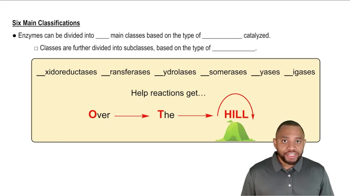
Review the six main classes of enzymes: oxidoreductases, transferases, hydrolases, lyases, isomerases, and ligases. Each class corresponds to a specific type of reaction.
Analyze the reaction provided in the problem (e.g., does it involve the transfer of electrons, breaking of bonds with water, or rearrangement of atoms within a molecule?).
Match the observed reaction type to the appropriate enzyme class. For example, if the reaction involves the addition or removal of water, the enzyme is likely a hydrolase.
Conclude the enzyme class based on the reaction's characteristics and provide reasoning for the classification.

비슷한 문제에 대한 검증된 영상 답변:
이 영상 해법은 위 문제에 도움이 된다고 튜터들이 추천한 것입니다.
영상 길이:
41s도움이 되었나요?
주요 개념
질문에 올바르게 답하기 위해 반드시 이해해야 하는 핵심 개념들은 다음과 같습니다.
Enzyme Classification
Enzymes are classified into six main categories based on the type of reaction they catalyze: oxidoreductases, transferases, hydrolases, lyases, isomerases, and ligases. Understanding the specific class of an enzyme helps in identifying its function and the biochemical processes it facilitates.
추천 영상:
가이드 코스
Six Main Classifications Concept 3
Enzyme Function
Enzymes are biological catalysts that speed up chemical reactions in living organisms by lowering the activation energy required. Each enzyme has a specific substrate it acts upon, and its activity can be influenced by factors such as temperature, pH, and the presence of inhibitors or activators.
추천 영상:
가이드 코스
Logarithmic Functions
Reaction Mechanism
The reaction mechanism describes the step-by-step process by which an enzyme converts substrates into products. This includes the formation of enzyme-substrate complexes and the transition states, which are crucial for understanding how enzymes achieve their catalytic effects and the overall kinetics of the reaction.
추천 영상:
가이드 코스
Alcohol Reactions: Dehydration Reactions Concept 1
관련 실천
교과서 질문
30
views
교과서 질문
Based on the structure shown for retinol (vitamin A) and the names of the two related forms of vitamin A, retinal and retinoic acid, what do you expect to be the structural differences among these three compounds?
750
views
교과서 질문
Answer questions (a)–(e) concerning the following reaction:
b. Since hydrogens are removed, the enzyme belongs to what subclass of the enzyme class from part (a)?
1064
views
교과서 질문
Vitamins are a diverse group of compounds that must be present in the diet. List four functions of vitamins in the body.
656
views
교과서 질문
Answer questions (a)–(e) concerning the following reaction:
d. What is the product for the reaction as written?
1416
views
교과서 질문
Answer questions (a)–(e) concerning the following reaction:
c. What is the substrate for the reaction as written?
1163
views