
Ch.19 Enzymes and Vitamins
McMurry - Fundamentals of General, Organic, and Biological Chemistry 8th Edition
McMurry8th EditionFundamentals of General, Organic, and Biological ChemistryISBN: 9780134015187당신이 사용하는 게 아니라요?교과서 변경
19장, 문제 19

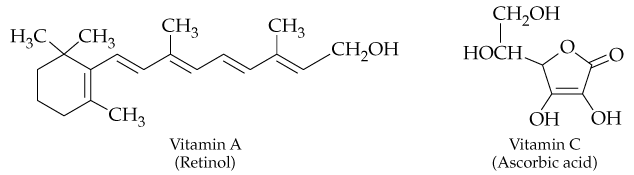
Compare the structures of vitamin A and vitamin C. Which one is water-soluble and which is fat-soluble? What structural features does each have that make one water-soluble and the other fat-soluble?

검증된 단계별 안내
1
Examine the structure of Vitamin A (Retinol). It contains a long hydrocarbon chain with multiple double bonds and a hydroxyl (-OH) group at one end. The hydrocarbon chain is nonpolar, making Vitamin A predominantly hydrophobic (fat-soluble).
Examine the structure of Vitamin C (Ascorbic acid). It contains multiple hydroxyl (-OH) groups and a lactone ring. These hydroxyl groups can form hydrogen bonds with water, making Vitamin C hydrophilic (water-soluble).
Identify the key structural feature that makes Vitamin A fat-soluble: the long nonpolar hydrocarbon chain dominates its solubility properties, allowing it to dissolve in fats and oils.
Identify the key structural feature that makes Vitamin C water-soluble: the presence of multiple polar hydroxyl (-OH) groups enables it to interact with water molecules through hydrogen bonding.
Conclude that Vitamin A is fat-soluble due to its hydrophobic hydrocarbon chain, while Vitamin C is water-soluble due to its hydrophilic hydroxyl groups and polar structure.

비슷한 문제에 대한 검증된 영상 답변:

이 영상 해법은 위 문제에 도움이 된다고 튜터들이 추천한 것입니다.
영상 길이:
2m
도움이 되었나요?

주요 개념

질문에 올바르게 답하기 위해 반드시 이해해야 하는 핵심 개념들은 다음과 같습니다.

Water-Solubility vs. Fat-Solubility

Water-soluble vitamins, like vitamin C, dissolve in water and are easily absorbed into the bloodstream. They are typically excreted through urine, which means they need to be consumed regularly. In contrast, fat-soluble vitamins, such as vitamin A, dissolve in fats and oils, allowing them to be stored in the body's fatty tissues and liver, making them less frequently required in the diet.
추천 영상:
가이드 코스
02:07
Solubility Rules

Chemical Structure of Vitamin A

Vitamin A (retinol) has a long hydrocarbon chain with a cyclic structure, which contributes to its fat-solubility. The presence of non-polar carbon chains allows it to dissolve in lipids, making it suitable for storage in fatty tissues. Its structure includes a hydroxyl group (-OH) that provides some polar characteristics, but overall, it remains predominantly hydrophobic.
추천 영상:
가이드 코스
00:58
Chemical Reaction: Chemical Change Concept 1

Chemical Structure of Vitamin C

Vitamin C (ascorbic acid) features multiple hydroxyl groups (-OH) and a lactone ring, which enhance its polarity and solubility in water. These polar functional groups allow vitamin C to interact favorably with water molecules, making it easily soluble and readily absorbed in the body. This structural characteristic is key to its classification as a water-soluble vitamin.
추천 영상:
가이드 코스
00:49
Chemical Reaction: Chemical Change Example 1