
Ch.19 Enzymes and Vitamins
McMurry - Fundamentals of General, Organic, and Biological Chemistry 8th Edition
McMurry8th EditionFundamentals of General, Organic, and Biological ChemistryISBN: 9780134015187당신이 사용하는 게 아니라요?교과서 변경
19장, 문제 52

How do you explain the observation that pepsin, a digestive enzyme found in the stomach, has a high catalytic activity at pH 1.5, while trypsin, an enzyme of the small intestine, has no activity at pH 1.5?

검증된 단계별 안내
1
Pepsin and trypsin are both enzymes, which are proteins that catalyze biochemical reactions. Each enzyme has an optimal pH at which it functions most effectively.
Pepsin is an enzyme that operates in the acidic environment of the stomach, where the pH is around 1.5. This acidic pH is optimal for pepsin's structure and function, allowing it to catalyze the breakdown of proteins effectively.
Trypsin, on the other hand, is an enzyme that functions in the small intestine, where the environment is more neutral, with a pH around 7 to 8. Trypsin's structure is adapted to this neutral pH, and it becomes inactive in highly acidic conditions like those in the stomach.
The difference in activity between pepsin and trypsin at pH 1.5 can be explained by the fact that enzymes have specific three-dimensional structures that are stabilized by interactions sensitive to pH. Changes in pH can alter these interactions, leading to denaturation or changes in the active site of the enzyme.
Thus, pepsin is active at pH 1.5 because its structure is stable and functional in acidic conditions, while trypsin is inactive because its structure is disrupted at this low pH, preventing it from catalyzing reactions.

비슷한 문제에 대한 검증된 영상 답변:

이 영상 해법은 위 문제에 도움이 된다고 튜터들이 추천한 것입니다.
영상 길이:
3m
도움이 되었나요?

주요 개념

질문에 올바르게 답하기 위해 반드시 이해해야 하는 핵심 개념들은 다음과 같습니다.

Enzyme Activity and pH

Enzymes are biological catalysts that facilitate chemical reactions in the body. Each enzyme has an optimal pH range where it functions most effectively. For instance, pepsin operates optimally in the highly acidic environment of the stomach (around pH 1.5), while trypsin, which is active in the more neutral conditions of the small intestine, is inactive at such low pH levels.
추천 영상:
가이드 코스
5:33
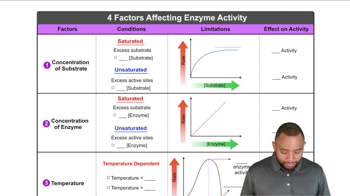
Factors Affecting Enzyme Activity Concept 2

Pepsin and Trypsin Function

Pepsin is a proteolytic enzyme that breaks down proteins into peptides in the stomach, thriving in acidic conditions. In contrast, trypsin, also a protease, functions in the small intestine where the pH is closer to neutral (around pH 7.5). The difference in their activity is due to their structural adaptations to their respective environments.
추천 영상:
가이드 코스
02:16
Logarithmic Functions

Enzyme Structure and Function

The structure of an enzyme is crucial for its function, as it determines how the enzyme interacts with substrates. Changes in pH can alter the ionization of amino acids at the active site, affecting the enzyme's shape and, consequently, its activity. Pepsin's structure is adapted to maintain its functionality in acidic conditions, while trypsin's structure is optimized for neutral pH.
추천 영상:
가이드 코스
02:16
Logarithmic Functions