Ch.19 Enzymes and Vitamins
McMurry - Fundamentals of General, Organic, and Biological Chemistry 8th Edition
McMurry8th EditionFundamentals of General, Organic, and Biological ChemistryISBN: 9780134015187당신이 사용하는 게 아니라요?교과서 변경
19장, 문제 49

Why is the induced-fit model a more likely model than the lock-and-key model?

검증된 단계별 안내
1
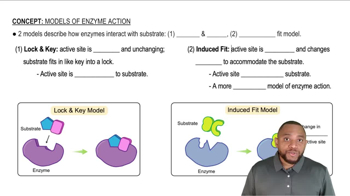
Understand the two models: The lock-and-key model suggests that the enzyme's active site is a perfect fit for the substrate, like a key fitting into a lock. The induced-fit model, on the other hand, proposes that the enzyme's active site is flexible and changes shape to accommodate the substrate upon binding.
Consider the dynamic nature of enzymes: Enzymes are not rigid structures; they are dynamic and can undergo conformational changes. The induced-fit model accounts for this flexibility, making it a more realistic representation of enzyme behavior.
Account for substrate diversity: Substrates can vary slightly in shape and size. The induced-fit model explains how enzymes can adjust to bind substrates that are not an exact match, whereas the lock-and-key model does not allow for such variability.
Explain the stabilization of the transition state: The induced-fit model suggests that the conformational change in the enzyme helps stabilize the transition state of the substrate, lowering the activation energy and facilitating the reaction. This is a key aspect of enzyme catalysis that the lock-and-key model does not address.
Summarize the evidence: Experimental data, such as X-ray crystallography and kinetic studies, support the induced-fit model by showing that enzymes often undergo structural changes upon substrate binding. This evidence makes the induced-fit model a more likely explanation of enzyme-substrate interactions.

비슷한 문제에 대한 검증된 영상 답변:

이 영상 해법은 위 문제에 도움이 된다고 튜터들이 추천한 것입니다.
영상 길이:
1m
도움이 되었나요?

주요 개념

질문에 올바르게 답하기 위해 반드시 이해해야 하는 핵심 개념들은 다음과 같습니다.

Induced-Fit Model

The induced-fit model suggests that enzyme active sites are flexible and can change shape to better fit the substrate upon binding. This dynamic interaction allows for a more precise fit, enhancing the enzyme's catalytic efficiency. It emphasizes the adaptability of enzymes, which can adjust their conformation to accommodate various substrates.
추천 영상:
가이드 코스
2:39
Models of Enzyme Action Concept 1

Lock-and-Key Model

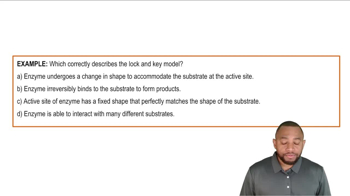
The lock-and-key model posits that enzymes and substrates fit together perfectly, like a key fitting into a lock. This model implies a static interaction where the enzyme's active site is rigid and specifically shaped for a particular substrate. While it provides a basic understanding of enzyme specificity, it does not account for the flexibility observed in many enzyme-substrate interactions.
추천 영상:
가이드 코스
1:26
Models of Enzyme Action Example 1

Enzyme Specificity

Enzyme specificity refers to the ability of an enzyme to selectively catalyze a particular reaction with a specific substrate. This concept is crucial for understanding how enzymes function in biological systems. The induced-fit model better explains the nuances of enzyme specificity, as it allows for variations in substrate structure and the enzyme's ability to adapt, leading to more efficient catalysis.
추천 영상:
가이드 코스
01:37
Specific Gravity