
Ch.19 Enzymes and Vitamins
McMurry - Fundamentals of General, Organic, and Biological Chemistry 8th Edition
McMurry8th EditionFundamentals of General, Organic, and Biological ChemistryISBN: 9780134015187당신이 사용하는 게 아니라요?교과서 변경
19장, 문제 56a

What general effects would you expect the following changes to have on the rate of an enzyme-catalyzed reaction for an enzyme that has its maximum activity at body temperature (about 37°C)?
a. Raising the temperature from 37°C to 70°C

검증된 단계별 안내
1
Understand that enzymes are proteins that catalyze biochemical reactions, and their activity is highly dependent on temperature. Enzymes have an optimal temperature at which they function most efficiently, often around body temperature (37°C) for human enzymes.
Recognize that raising the temperature generally increases the kinetic energy of molecules, which can lead to more frequent and effective collisions between the enzyme and substrate, potentially increasing the reaction rate initially.
However, as the temperature rises significantly above the enzyme's optimal temperature (e.g., from 37°C to 70°C), the enzyme's structure may begin to denature. Denaturation is the process where the enzyme's three-dimensional structure is disrupted, leading to a loss of its active site and catalytic function.
Consider that at 70°C, the enzyme is likely to be partially or fully denatured, resulting in a significant decrease or complete loss of its catalytic activity. This is because the hydrogen bonds and other interactions stabilizing the enzyme's structure are disrupted at high temperatures.
Conclude that raising the temperature from 37°C to 70°C would initially increase the reaction rate slightly, but as the enzyme denatures, the reaction rate would decrease dramatically, potentially stopping altogether if the enzyme is fully denatured.

비슷한 문제에 대한 검증된 영상 답변:

이 영상 해법은 위 문제에 도움이 된다고 튜터들이 추천한 것입니다.
영상 길이:
3m
도움이 되었나요?

주요 개념

질문에 올바르게 답하기 위해 반드시 이해해야 하는 핵심 개념들은 다음과 같습니다.

Enzyme Activity

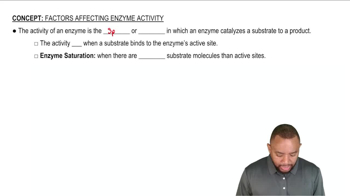
Enzyme activity refers to the rate at which an enzyme catalyzes a reaction. It is influenced by various factors, including temperature, pH, and substrate concentration. Enzymes typically have an optimal temperature range where they function most efficiently, and deviations from this range can lead to decreased activity or denaturation.
추천 영상:
가이드 코스
1:06
Factors Affecting Enzyme Activity Concept 1

Denaturation

Denaturation is the process by which an enzyme's three-dimensional structure is altered, leading to a loss of its biological activity. High temperatures can disrupt the hydrogen bonds and other interactions that maintain the enzyme's shape, resulting in a permanent change that prevents the enzyme from binding to its substrate effectively.
추천 영상:
가이드 코스
1:17
Digestion of Proteins Example 1

Temperature and Reaction Rate

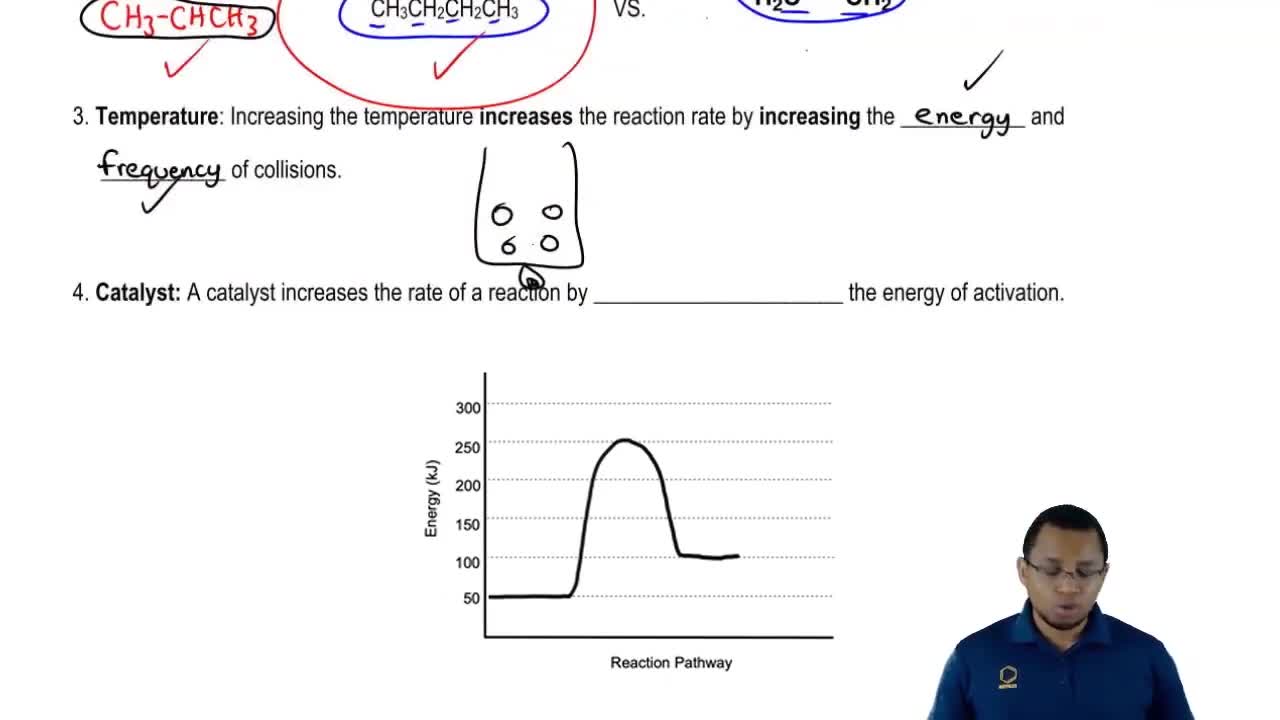
Temperature affects the kinetic energy of molecules, which in turn influences the rate of enzyme-catalyzed reactions. Generally, as temperature increases, reaction rates increase due to more frequent collisions between enzymes and substrates, up to a point. Beyond the optimal temperature, however, the rate declines sharply due to denaturation.
추천 영상:
가이드 코스
02:16
Rate of Reaction Concept 7