Look at the open-chain form of D-mannose and draw the two glycosidic products that you expect to obtain by reacting D-mannose with methanol.
Ch.20 Carbohydrates
McMurry8th EditionFundamentals of General, Organic, and Biological ChemistryISBN: 9780134015187당신이 사용하는 게 아니라요?교과서 변경
20장, 문제 59
Draw a disaccharide of two cyclic mannose molecules attached by an α-1,4 glycosidic linkage. Explain why the glycosidic products in Problem 20.58 are not reducing sugars, but the product in this problem is a reducing sugar.
검증된 단계별 안내1
Step 1: Understand the structure of mannose. Mannose is a hexose sugar with the molecular formula C₆H₁₂O₆. In its cyclic form, it exists as a six-membered ring (pyranose) with an anomeric carbon at position 1. The α-anomer has the hydroxyl group on the anomeric carbon pointing down relative to the ring plane.
Step 2: Draw two cyclic mannose molecules. Represent each mannose molecule in its pyranose form, ensuring that the anomeric carbon (C1) is clearly labeled. For the first mannose molecule, use the α-anomer configuration.
Step 3: Form the α-1,4 glycosidic linkage. Connect the anomeric carbon (C1) of the first mannose molecule to the hydroxyl group on carbon 4 (C4) of the second mannose molecule. This bond is called an α-1,4 glycosidic linkage because the linkage involves the α-anomer of the first mannose and the C4 position of the second mannose.
Step 4: Explain why the product is a reducing sugar. A reducing sugar has a free anomeric carbon that can open to form an aldehyde group. In this disaccharide, the second mannose molecule retains its free anomeric carbon (C1), which is not involved in the glycosidic bond. This allows the second mannose to act as a reducing sugar.
Step 5: Contrast with Problem 20.58. In Problem 20.58, the glycosidic products are not reducing sugars because all anomeric carbons are involved in glycosidic bonds, leaving no free anomeric carbon to open and form an aldehyde group. This structural difference explains why the disaccharide in this problem is a reducing sugar, while the products in Problem 20.58 are not.

비슷한 문제에 대한 검증된 영상 답변:
이 영상 해법은 위 문제에 도움이 된다고 튜터들이 추천한 것입니다.
영상 길이:
2m도움이 되었나요?
주요 개념
질문에 올바르게 답하기 위해 반드시 이해해야 하는 핵심 개념들은 다음과 같습니다.
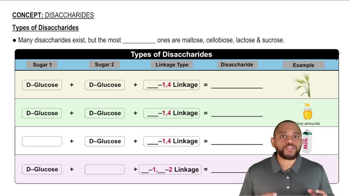
Disaccharides
Disaccharides are carbohydrates formed by the condensation of two monosaccharides, resulting in a glycosidic bond. In this case, the disaccharide consists of two cyclic mannose molecules linked by an α-1,4 glycosidic bond. This structure is crucial for understanding how sugars can vary in their properties, including their ability to act as reducing or non-reducing sugars.
추천 영상:
가이드 코스
Types of Disaccharides Concept 1
Glycosidic Linkage
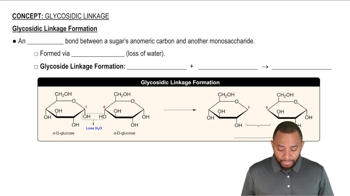
A glycosidic linkage is a covalent bond that connects a carbohydrate molecule to another group, which can be another carbohydrate. The type of glycosidic bond (e.g., α or β) influences the sugar's reactivity and properties. In this context, the α-1,4 glycosidic linkage allows the disaccharide to retain a free anomeric carbon, which is essential for its classification as a reducing sugar.
추천 영상:
가이드 코스
Glycosidic Linkage Formation Concept 1
Reducing Sugars
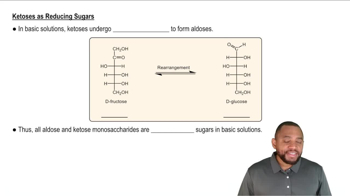
Reducing sugars are carbohydrates that can donate electrons to other molecules, typically due to the presence of a free aldehyde or ketone group. In the case of the disaccharide formed from mannose, the free anomeric carbon allows it to act as a reducing sugar. In contrast, glycosidic products that do not have a free anomeric carbon are classified as non-reducing sugars, as they cannot participate in redox reactions.
추천 영상:
가이드 코스
Ketoses as Reducing Sugars Concept 2
관련 실천
교과서 질문
1407
views
교과서 질문
Oxidation of the aldehyde group of ribose yields a carboxylic acid. Draw the structure of ribonic acid.
642
views
교과서 질문
Amylose (a form of starch) and cellulose are both polymers of glucose. What is the main structural difference between them? What roles do these two polymers have in nature?
574
views
교과서 질문
How are amylose and amylopectin similar to each other, and how are they different from each other?
595
views
교과서 질문
Treatment of an aldose with an oxidizing agent such as Tollens’ reagent yields a carboxylic acid. Gluconic acid, the product of glucose oxidation, is used as its magnesium salt for the treatment of magnesium deficiency. Draw the structure of gluconic acid.
624
views
교과서 질문
Lactose and maltose are reducing disaccharides, but sucrose is a nonreducing disaccharide. Explain.
950
views