Ch.20 Carbohydrates
McMurry - Fundamentals of General, Organic, and Biological Chemistry 8th Edition
McMurry8th EditionFundamentals of General, Organic, and Biological ChemistryISBN: 9780134015187당신이 사용하는 게 아니라요?교과서 변경
20장, 문제 58

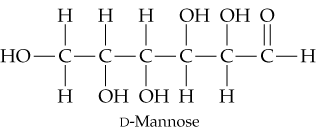
Look at the open-chain form of D-mannose and draw the two glycosidic products that you expect to obtain by reacting D-mannose with methanol.

검증된 단계별 안내
1
Identify the structure of the open-chain form of D-mannose. D-mannose is an aldohexose, meaning it contains six carbon atoms and an aldehyde group at the first carbon. The hydroxyl groups on the other carbons are arranged in a specific stereochemical configuration.
Understand the reaction: When D-mannose reacts with methanol in the presence of an acid catalyst, it undergoes a cyclization reaction to form a hemiacetal. This reaction can occur at the aldehyde group (C1) and any of the hydroxyl groups on the molecule, but the most common products involve the hydroxyl group on C5, forming a six-membered ring (pyranose) or the hydroxyl group on C4, forming a five-membered ring (furanose).
Determine the two possible glycosidic products: The reaction with methanol will replace the hydroxyl group at the anomeric carbon (C1) with a methoxy group (-OCH₃), forming a glycosidic bond. This can occur in two configurations: alpha (where the methoxy group is on the opposite side of the ring relative to the CH₂OH group at C5) or beta (where the methoxy group is on the same side as the CH₂OH group).
Draw the structures of the two products: For the pyranose form, draw a six-membered ring with the methoxy group at C1 in either the alpha or beta configuration. For the furanose form, draw a five-membered ring with the methoxy group at C1 in either the alpha or beta configuration. Ensure the stereochemistry of the other hydroxyl groups matches that of D-mannose.
Label the products clearly: Indicate which product is the alpha-pyranoside, beta-pyranoside, alpha-furanoside, and beta-furanoside. These are the four possible glycosidic products that can form from the reaction of D-mannose with methanol.

비슷한 문제에 대한 검증된 영상 답변:

이 영상 해법은 위 문제에 도움이 된다고 튜터들이 추천한 것입니다.
영상 길이:
11m
도움이 되었나요?

주요 개념

질문에 올바르게 답하기 위해 반드시 이해해야 하는 핵심 개념들은 다음과 같습니다.

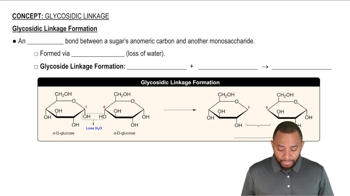
Glycosidic Bond Formation

A glycosidic bond is a type of covalent bond that connects a carbohydrate (sugar) molecule to another group, which can be another sugar or a different molecule. In the context of d-mannose reacting with methanol, this bond forms when the hydroxyl group of the sugar reacts with the alcohol, resulting in the release of water and the formation of an ether linkage.
추천 영상:
가이드 코스
1:44
Glycosidic Linkage Formation Concept 1

D-Mannose Structure

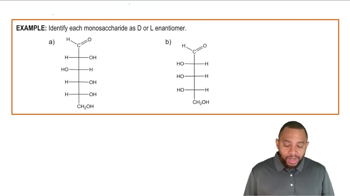
D-mannose is a simple sugar and an aldohexose, which means it contains six carbon atoms and an aldehyde group. Its open-chain form consists of a linear arrangement of carbon atoms with hydroxyl groups attached. Understanding its structure is crucial for predicting the products of its reaction with methanol, as the specific hydroxyl groups involved will determine the resulting glycosidic products.
추천 영상:
가이드 코스
0:56
D vs L Enantiomers Example 1

Methanol as a Reactant

Methanol is a simple alcohol that can act as a nucleophile in glycosidic bond formation. When d-mannose reacts with methanol, the hydroxyl group of methanol can attack the anomeric carbon of d-mannose, leading to the formation of methyl glycosides. This reaction is significant in carbohydrate chemistry as it illustrates how sugars can be modified to create various derivatives.
추천 영상:
가이드 코스
08:01
Distillation and Floatation