
Ch.22 Carbohydrate Metabolism
McMurry - Fundamentals of General, Organic, and Biological Chemistry 8th Edition
McMurry8th EditionFundamentals of General, Organic, and Biological ChemistryISBN: 9780134015187당신이 사용하는 게 아니라요?교과서 변경
22장, 문제 4

Identify each step in glycolysis that is an isomerization.

검증된 단계별 안내
1
Step 1: Understand the concept of isomerization. Isomerization is a chemical reaction where a molecule is transformed into another molecule with the same molecular formula but a different structural arrangement. In glycolysis, this involves the rearrangement of atoms within a molecule without adding or removing atoms.
Step 2: Recall the steps of glycolysis. Glycolysis is a 10-step metabolic pathway that converts glucose into pyruvate, producing ATP and NADH in the process. Each step is catalyzed by a specific enzyme.
Step 3: Identify the isomerization steps in glycolysis. The first isomerization occurs in Step 2, where glucose-6-phosphate is converted into fructose-6-phosphate. This reaction is catalyzed by the enzyme phosphoglucose isomerase.
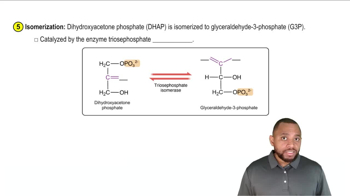
Step 4: Identify the second isomerization step. The second isomerization occurs in Step 5, where dihydroxyacetone phosphate (DHAP) is converted into glyceraldehyde-3-phosphate (G3P). This reaction is catalyzed by the enzyme triose phosphate isomerase.
Step 5: Summarize the isomerization steps. In glycolysis, the isomerization reactions are Step 2 (glucose-6-phosphate to fructose-6-phosphate) and Step 5 (dihydroxyacetone phosphate to glyceraldehyde-3-phosphate). These steps involve structural rearrangements of the molecules to facilitate subsequent reactions in the pathway.

비슷한 문제에 대한 검증된 영상 답변:

이 영상 해법은 위 문제에 도움이 된다고 튜터들이 추천한 것입니다.
영상 길이:
11m
도움이 되었나요?

주요 개념

질문에 올바르게 답하기 위해 반드시 이해해야 하는 핵심 개념들은 다음과 같습니다.

Glycolysis

Glycolysis is a metabolic pathway that converts glucose into pyruvate, producing energy in the form of ATP and NADH. It consists of ten enzymatic reactions, which can be divided into two phases: the energy investment phase and the energy payoff phase. Understanding glycolysis is essential for identifying specific steps that involve isomerization, where molecules are rearranged to form isomers.
추천 영상:
가이드 코스
1:26
Glycolysis Concept 5

Isomerization

Isomerization is a chemical process in which a molecule is transformed into another molecule with the same atoms but in a different arrangement. In glycolysis, isomerization reactions are crucial for facilitating the conversion of substrates into forms that can be further processed in subsequent steps. This rearrangement is vital for the efficient progression of the glycolytic pathway.
추천 영상:
가이드 코스
1:26
Glycolysis Concept 5

Enzymatic Reactions in Glycolysis

Enzymatic reactions in glycolysis are catalyzed by specific enzymes that facilitate each step of the pathway. In the context of isomerization, two key enzymes are phosphoglucose isomerase, which converts glucose-6-phosphate to fructose-6-phosphate, and triose phosphate isomerase, which interconverts dihydroxyacetone phosphate and glyceraldehyde-3-phosphate. Recognizing these enzymatic steps is essential for identifying isomerization events in glycolysis.
추천 영상:
가이드 코스
1:26
Glycolysis Concept 5