Ch.26 Nucleic Acids and Protein Synthesis
McMurry - Fundamentals of General, Organic, and Biological Chemistry 8th Edition
McMurry8th EditionFundamentals of General, Organic, and Biological ChemistryISBN: 9780134015187당신이 사용하는 게 아니라요?교과서 변경
26장, 문제 47

How are replication, transcription, and translation similar? How are they different?

검증된 단계별 안내
1
Replication, transcription, and translation are all essential biological processes involved in the flow of genetic information, but they serve different purposes and occur in different contexts.
Replication is the process by which DNA is copied to produce two identical DNA molecules. It occurs during the S phase of the cell cycle and ensures that each daughter cell receives a complete set of genetic information. The key enzymes involved are DNA helicase (unwinding the DNA), DNA polymerase (synthesizing the new DNA strand), and ligase (joining fragments).
Transcription is the process of synthesizing RNA from a DNA template. It occurs in the nucleus of eukaryotic cells and involves the enzyme RNA polymerase, which binds to the DNA at the promoter region and synthesizes a complementary RNA strand. The product is messenger RNA (mRNA), which carries the genetic code to the ribosome.
Translation is the process by which the mRNA sequence is decoded to synthesize a protein. This occurs in the ribosome, where transfer RNA (tRNA) molecules bring specific amino acids corresponding to the codons on the mRNA. The ribosome facilitates the formation of peptide bonds between amino acids, creating a polypeptide chain.
The main differences are: replication copies DNA to DNA, transcription converts DNA to RNA, and translation converts RNA to protein. Replication and transcription occur in the nucleus, while translation occurs in the cytoplasm. Additionally, replication involves the entire DNA molecule, while transcription and translation focus on specific genes.

비슷한 문제에 대한 검증된 영상 답변:

이 영상 해법은 위 문제에 도움이 된다고 튜터들이 추천한 것입니다.
영상 길이:
2m
도움이 되었나요?

주요 개념

질문에 올바르게 답하기 위해 반드시 이해해야 하는 핵심 개념들은 다음과 같습니다.

Replication

Replication is the process by which a cell duplicates its DNA, ensuring that each daughter cell receives an exact copy of the genetic material. This occurs during the S phase of the cell cycle and involves enzymes like DNA polymerase, which synthesize new strands complementary to the original DNA template.
추천 영상:
가이드 코스
1:40
Intro to DNA Replication Example 2

Transcription

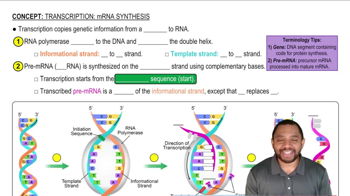
Transcription is the process of synthesizing RNA from a DNA template. During transcription, the enzyme RNA polymerase binds to a specific region of the DNA and creates a single-stranded RNA molecule that carries the genetic information needed for protein synthesis. This process occurs in the nucleus in eukaryotic cells.
추천 영상:
가이드 코스
6:37
Transcription: mRNA Synthesis Concept 1

Translation

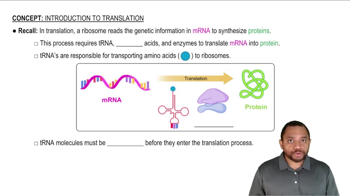
Translation is the process by which the information encoded in messenger RNA (mRNA) is used to synthesize proteins. This occurs in the ribosome, where transfer RNA (tRNA) molecules bring amino acids that correspond to the codons in the mRNA sequence, ultimately forming a polypeptide chain that folds into a functional protein.
추천 영상:
가이드 코스
1:42
Introduction to Translation Concept 1