Ch.26 Nucleic Acids and Protein Synthesis
McMurry - Fundamentals of General, Organic, and Biological Chemistry 8th Edition
McMurry8th EditionFundamentals of General, Organic, and Biological ChemistryISBN: 9780134015187당신이 사용하는 게 아니라요?교과서 변경
26장, 문제 57a

Which amino acid(s) have the most codons?

검증된 단계별 안내
1
Understand that codons are sequences of three nucleotides in mRNA that correspond to specific amino acids or stop signals during protein synthesis.
Recall that there are 64 possible codons in the genetic code, but only 20 amino acids are encoded, meaning some amino acids are represented by multiple codons.
Identify that amino acids with the most codons are those with the highest redundancy in the genetic code. For example, leucine, serine, and arginine each have six codons.
Review the genetic code table to confirm which amino acids have the highest number of codons and compare them to others with fewer codons.
Conclude that amino acids with six codons (leucine, serine, and arginine) are the ones with the most codons, based on the genetic code table.

비슷한 문제에 대한 검증된 영상 답변:

이 영상 해법은 위 문제에 도움이 된다고 튜터들이 추천한 것입니다.
영상 길이:
41s
도움이 되었나요?

주요 개념

질문에 올바르게 답하기 위해 반드시 이해해야 하는 핵심 개념들은 다음과 같습니다.

Codons

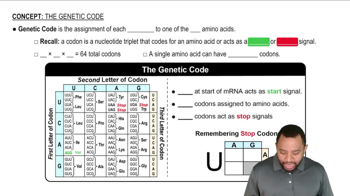
Codons are sequences of three nucleotides in mRNA that correspond to specific amino acids or stop signals during protein synthesis. There are 64 possible codons, but only 20 standard amino acids, leading to redundancy in the genetic code. This redundancy means that some amino acids are encoded by multiple codons, which is crucial for understanding which amino acids have the most codons.
추천 영상:
가이드 코스
03:25
The Genetic Code Concept 1

Amino Acids

Amino acids are organic compounds that serve as the building blocks of proteins. There are 20 standard amino acids, each defined by its unique side chain or R group. The diversity in codons allows for certain amino acids, like leucine, serine, and arginine, to be encoded by multiple codons, which is important for protein synthesis and function.
추천 영상:
가이드 코스
3:03
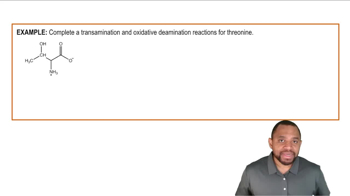
Amino Acid Catabolism: Amino Group Example 2

Genetic Code

The genetic code is the set of rules by which information encoded in genetic material is translated into proteins. It consists of codons that specify which amino acids will be added during protein synthesis. Understanding the genetic code is essential for determining which amino acids have the most codons, as it reveals the relationships between nucleotide sequences and the resulting amino acids.
추천 영상:
가이드 코스
03:25
The Genetic Code Concept 1