Ch.26 Nucleic Acids and Protein Synthesis
McMurry - Fundamentals of General, Organic, and Biological Chemistry 8th Edition
McMurry8th EditionFundamentals of General, Organic, and Biological ChemistryISBN: 9780134015187당신이 사용하는 게 아니라요?교과서 변경
26장, 문제 62

If the sequence T-A-C-C-C-T appears on the informational strand of DNA, what sequence appears opposite it on the template strand? Label your answer with 3′ and 5′ ends.

검증된 단계별 안내
1
Understand that DNA is composed of two complementary strands, where the bases pair according to specific rules: Adenine (A) pairs with Thymine (T), and Cytosine (C) pairs with Guanine (G).
The informational strand is given as T-A-C-C-C-T. To determine the complementary template strand, replace each base with its complementary base: T pairs with A, A pairs with T, C pairs with G, and so on.
Write the complementary sequence for the template strand: For each base in the informational strand (T-A-C-C-C-T), write the complementary base below it.
Label the ends of the template strand. DNA strands are antiparallel, meaning the 5′ end of one strand aligns with the 3′ end of the other. If the informational strand is written from 5′ to 3′, the template strand will be written from 3′ to 5′.
Combine the complementary bases and the 3′ and 5′ labels to finalize the sequence of the template strand, ensuring the directionality is correct.

비슷한 문제에 대한 검증된 영상 답변:

이 영상 해법은 위 문제에 도움이 된다고 튜터들이 추천한 것입니다.
영상 길이:
4m
도움이 되었나요?

주요 개념

질문에 올바르게 답하기 위해 반드시 이해해야 하는 핵심 개념들은 다음과 같습니다.

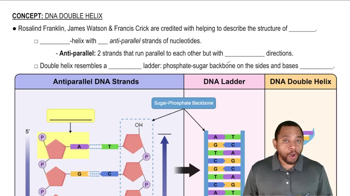
DNA Structure

DNA is composed of two strands that form a double helix, with each strand consisting of nucleotides. Each nucleotide contains a phosphate group, a sugar, and a nitrogenous base (adenine, thymine, cytosine, or guanine). The strands are antiparallel, meaning one runs in the 5' to 3' direction while the other runs 3' to 5'. This orientation is crucial for understanding how complementary base pairing occurs.
추천 영상:
가이드 코스
3:27
DNA Double Helix Concept 1

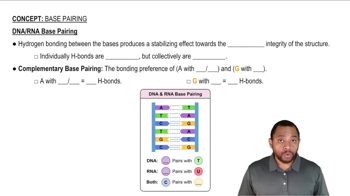
Complementary Base Pairing

In DNA, specific nitrogenous bases pair with one another: adenine (A) pairs with thymine (T), and cytosine (C) pairs with guanine (G). This pairing is essential for the accurate replication and transcription of genetic information. When determining the sequence on the template strand, one must identify the complementary bases for each base in the given sequence.
추천 영상:
가이드 코스
2:56
Base Pairing Concept 1

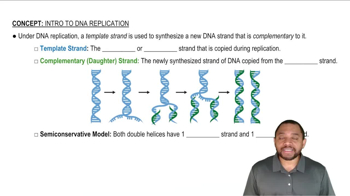
Template Strand

The template strand of DNA serves as a guide for synthesizing a complementary strand during processes like DNA replication and transcription. The sequence of nucleotides on the template strand dictates the sequence of the newly synthesized strand, which is built in the 5' to 3' direction. Understanding which strand is the template is key to determining the correct complementary sequence.
추천 영상:
가이드 코스
2:20
Intro to DNA Replication Concept 1