Ch.26 Nucleic Acids and Protein Synthesis
McMurry - Fundamentals of General, Organic, and Biological Chemistry 8th Edition
McMurry8th EditionFundamentals of General, Organic, and Biological ChemistryISBN: 9780134015187당신이 사용하는 게 아니라요?교과서 변경
26장, 문제 65

What tetrapeptide is synthesized from the informational DNA sequence G-T-C-A-G-T-A-C-G-T-T-A?

검증된 단계별 안내
1
Step 1: Understand the problem. The DNA sequence provided (G-T-C-A-G-T-A-C-G-T-T-A) needs to be translated into a tetrapeptide. This involves determining the mRNA sequence, identifying the codons, and then using the genetic code to find the corresponding amino acids.
Step 2: Transcribe the DNA sequence into mRNA. Replace each DNA base with its complementary RNA base: G (guanine) pairs with C (cytosine), T (thymine) pairs with A (adenine), A (adenine) pairs with U (uracil), and C (cytosine) pairs with G (guanine). The resulting mRNA sequence will be C-A-G-U-C-A-U-G-C-A-A-U.
Step 3: Divide the mRNA sequence into codons. Codons are groups of three nucleotides that correspond to specific amino acids. For the mRNA sequence C-A-G-U-C-A-U-G-C-A-A-U, the codons are CAG, UCA, UGC, and AAU.
Step 4: Use the genetic code to determine the amino acid for each codon. Refer to a codon chart to find the amino acids corresponding to CAG, UCA, UGC, and AAU. Each codon will translate to a specific amino acid.
Step 5: Combine the amino acids in the order determined by the codons to form the tetrapeptide. Write the sequence of the tetrapeptide using the standard three-letter or one-letter abbreviations for the amino acids.

비슷한 문제에 대한 검증된 영상 답변:

이 영상 해법은 위 문제에 도움이 된다고 튜터들이 추천한 것입니다.
영상 길이:
1m
도움이 되었나요?

주요 개념

질문에 올바르게 답하기 위해 반드시 이해해야 하는 핵심 개념들은 다음과 같습니다.

DNA Sequence

A DNA sequence is a series of nucleotides that encode genetic information. Each nucleotide consists of a sugar, a phosphate group, and a nitrogenous base (adenine, thymine, cytosine, or guanine). The specific order of these bases determines the genetic instructions for synthesizing proteins, including peptides.
추천 영상:
가이드 코스
1:49
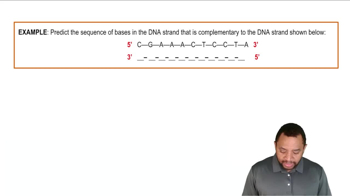
DNA Double Helix Example 1

Transcription and Translation

Transcription is the process by which the DNA sequence is copied into messenger RNA (mRNA), which then undergoes translation to synthesize proteins. During translation, ribosomes read the mRNA sequence in sets of three nucleotides (codons), each corresponding to a specific amino acid, ultimately forming a polypeptide chain.
추천 영상:
가이드 코스
6:37
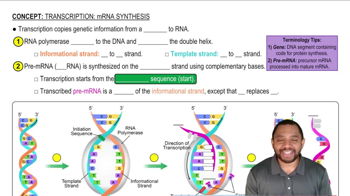
Transcription: mRNA Synthesis Concept 1

Tetrapeptide

A tetrapeptide is a peptide composed of four amino acids linked by peptide bonds. The sequence of amino acids in a tetrapeptide is determined by the corresponding mRNA codons, which are derived from the original DNA sequence. Understanding how to translate the DNA sequence into a tetrapeptide involves knowing the genetic code that associates specific codons with their respective amino acids.
추천 영상:
가이드 코스
1:24
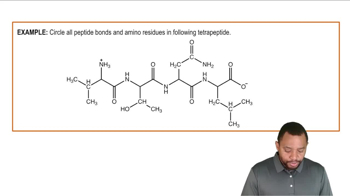
Peptides Example 1