Is a DNA molecule neutral, negatively charged, or positively charged? Explain.
Ch.26 Nucleic Acids and Protein Synthesis
McMurry8th EditionFundamentals of General, Organic, and Biological ChemistryISBN: 9780134015187당신이 사용하는 게 아니라요?교과서 변경
26장, 문제 8a
Write the complementary sequence of bases for each DNA strand shown next.
a. 5′T-A-T-A-C-T-G 3′
검증된 단계별 안내1
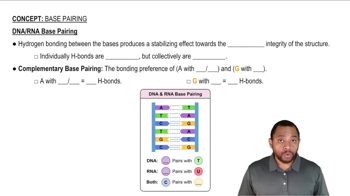
Identify the base-pairing rules for DNA: Adenine (A) pairs with Thymine (T), and Cytosine (C) pairs with Guanine (G).
Write the complementary base for each nucleotide in the given sequence, starting from the 5′ end of the original strand. For example, if the original strand has 'T', the complementary base will be 'A'.
Ensure the complementary strand is written in the 3′ to 5′ direction, as DNA strands are antiparallel.
For the given sequence 5′T-A-T-A-C-T-G 3′, apply the base-pairing rules to each nucleotide: T pairs with A, A pairs with T, C pairs with G, and G pairs with C.
Write the final complementary sequence in the 3′ to 5′ direction, ensuring the correct orientation of the strand.

비슷한 문제에 대한 검증된 영상 답변:
이 영상 해법은 위 문제에 도움이 된다고 튜터들이 추천한 것입니다.
영상 길이:
3m도움이 되었나요?
주요 개념
질문에 올바르게 답하기 위해 반드시 이해해야 하는 핵심 개념들은 다음과 같습니다.
DNA Structure
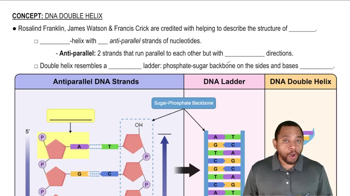
DNA is composed of two strands forming a double helix, with each strand made up of nucleotides. Each nucleotide consists of a sugar, a phosphate group, and a nitrogenous base. The four types of nitrogenous bases are adenine (A), thymine (T), cytosine (C), and guanine (G). The bases pair specifically: A with T and C with G, which is crucial for understanding complementary sequences.
추천 영상:
가이드 코스
DNA Double Helix Concept 1
Complementary Base Pairing
Complementary base pairing refers to the specific pairing of nitrogenous bases in DNA. Adenine pairs with thymine (A-T), and cytosine pairs with guanine (C-G). This pairing is essential for DNA replication and transcription, as it ensures that the genetic information is accurately copied and transmitted. Understanding this concept is key to determining the complementary sequence of a given DNA strand.
추천 영상:
가이드 코스
Base Pairing Concept 1
5' and 3' Ends of DNA Strands
DNA strands have directionality, indicated by the 5' (five-prime) and 3' (three-prime) ends. The 5' end has a phosphate group, while the 3' end has a hydroxyl group. When writing or reading DNA sequences, it is important to maintain this orientation, as it affects how the strands interact during processes like replication and transcription. This directional aspect is crucial for accurately determining complementary sequences.
추천 영상:
가이드 코스
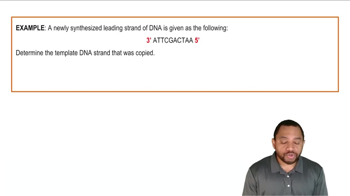
Intro to DNA Replication Example 3
관련 실천
교과서 질문
1043
views
교과서 질문
Name the bases in the pentanucleotide with the sequence G-A-U-C-A. Does this come from RNA or DNA? Explain.
891
views
교과서 질문
Write the full name of:
a. dUMP
1214
views
교과서 질문
Name the nucleoside shown here. Copy the structure, and number the C and N atoms (refer to Table 26.1).
529
views
교과서 질문
Draw the structures of adenine and uracil (which replaces thymine in RNA), and show the hydrogen bonding that occurs between them.
853
views
교과서 질문
DNA and RNA, like proteins, can be denatured to produce unfolded or uncoiled strands. Heating DNA to what is referred to as its “melting temperature” denatures it (the two strands of the double helix become separated). Why does a longer strand of DNA have a higher melting temperature than a shorter one?
692
views